
Tajweed · Beginner Guide
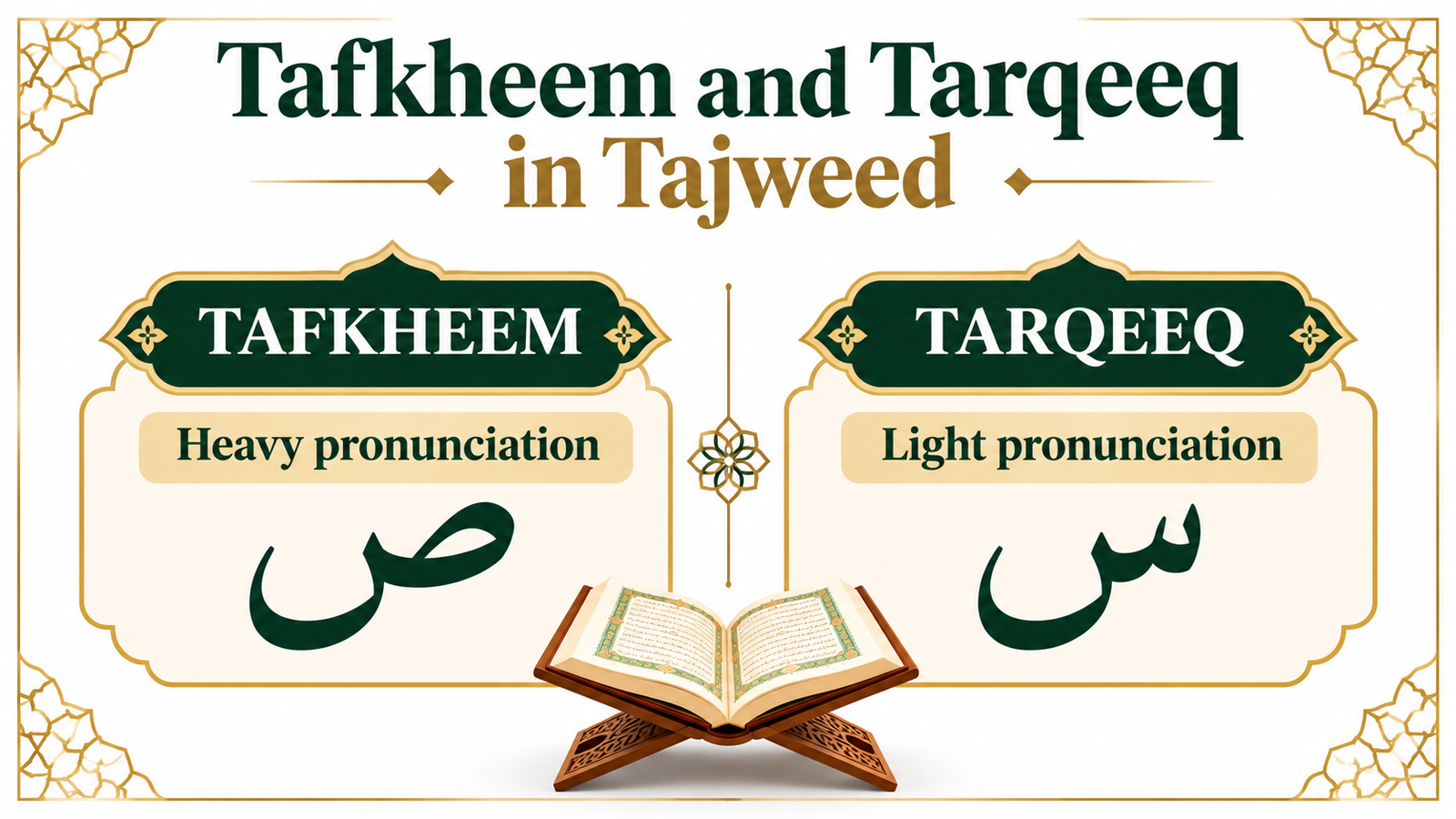
Correct Quran recitation depends on pronouncing every Arabic letter with its proper characteristics. Some Arabic letters have a strong, heavy sound, while others are pronounced lightly. In Tajweed, these qualities are known as Tafkheem and Tarqeeq.
Understanding these rules helps learners distinguish similar Arabic letters, improve pronunciation, and recite the Holy Quran more accurately. In this guide, we will explain Tafkheem and Tarqeeq, the seven heavy letters, the special rules of Raa and Laam, and simple Quranic examples for beginners.
What Is Tafkheem in Tajweed?
Tafkheem (التَّفْخِيم) means heaviness or fullness in pronunciation. In Tajweed, Tafkheem refers to producing a letter with a full, emphatic sound. This usually involves raising the back of the tongue toward the upper palate, which changes the resonance inside the mouth.
For example, the letter ص (Saad) has a heavier sound than س (Seen). Tafkheem does not mean shouting, applying excessive force, or unnecessarily stretching the sound. It means pronouncing the letter with its correct heavy quality.
What Is Tarqeeq in Tajweed?
Tarqeeq (التَّرْقِيق) means lightness or thinness in pronunciation. It refers to producing a letter without the heavy resonance associated with Tafkheem.
For example, س (Seen) is pronounced lightly, while ص (Saad) has an emphatic quality. Most Arabic letters are generally light, although certain letters change between heavy and light pronunciation depending on their vowel or surrounding sounds.
Difference Between Tafkheem and Tarqeeq
| Tafkheem | Tarqeeq |
|---|---|
| Heavy or emphatic pronunciation | Light or thin pronunciation |
| The back of the tongue is raised | No comparable emphatic tongue raising |
| Produces a fuller resonance | Produces a lighter resonance |
| Example: ص (Saad) | Example: س (Seen) |
| Example: ط (Taa) | Example: ت (Ta) |
Both qualities are important because incorrect pronunciation can make one Arabic letter sound like another.
The Seven Letters of Tafkheem (Huroof al-Isti'la)
There are seven Arabic letters that always carry the characteristic of Isti'la, or elevation. These are called Huroof al-Isti'la (حُرُوفُ الِاسْتِعْلَاءِ).
خ ص ض غ ط ق ظ
They are commonly memorised through the phrase خُصَّ ضَغْطٍ قِظْ. These letters remain heavy whether they carry Fathah, Dammah, Kasrah, or Sukoon. However, the degree of heaviness changes.
Quranic Examples of Heavy Letters
| Letter | Quranic example | Reference |
|---|---|---|
| خ | خَلَقَ | Surah Al-Alaq (96:2) |
| ص | الصِّرَاطَ | Surah Al-Fatihah (1:6) |
| ض | الْمَغْضُوبِ | Surah Al-Fatihah (1:7) |
| غ | غَيْرِ | Surah Al-Fatihah (1:7) |
| ط | طَيِّبًا | Surah Al-Baqarah (2:168) |
| ق | قُلْ | Surah Al-Ikhlas (112:1) |
| ظ | ظَلَمُوا | Surah Al-Baqarah (2:59) |
Even when a heavy letter carries Kasrah, such as ص in الصِّرَاطَ, it maintains Isti'la. Among the seven heavy letters, ص، ض، ط، ظ also possess Itbaq, giving their articulation an additional compressed quality.
What Are the Levels of Tafkheem?
Heavy letters do not always have exactly the same degree of heaviness. One commonly taught classification describes five levels of Tafkheem.
| Level | Condition | Example |
|---|---|---|
| 1. Strongest | Fathah followed by Madd Alif | قَالَ |
| 2. Strong | Fathah without Madd Alif | خَلَقَ |
| 3. Moderate | Dammah | قُلْ |
| 4. Context-dependent | Sukoon | يَقْطَعُونَ |
| 5. Lightest degree of heaviness | Kasrah | قِيلَ |
The level involving Sukoon is influenced by the preceding vowel. Some Tajweed traditions use three levels instead of five or arrange Sakin letters differently. These systems describe degrees of heaviness, not a different set of heavy letters.
Important: A heavy letter with Kasrah is still heavy. It must not be changed into a light letter.
Which Arabic Letters Are Pronounced Lightly?
Letters possessing Istifal are generally pronounced with Tarqeeq. Common examples include:
ب، ت، ث، ج، ح، د، ذ، س، ش، ف، ك، م، ن، ه، و، ي
- سَمِعَ: Seen is light.
- كَانَ: Kaaf is light.
- بِسْمِ: Ba and Seen are light.
Three letters require extra attention: Raa (ر) can be heavy or light; Laam (ل) is generally light but follows special rules in Allah's name; and Madd Alif (ا) follows the pronunciation of the preceding letter.
Rules of Raa (ر) in Tajweed
Raa changes between Tafkheem and Tarqeeq according to its vowel, nearby letters, and sometimes whether the reader is stopping.
When Is Raa Pronounced Heavy?
1. With Fathah (رَ): In رَبِّ الْعَالَمِينَ (Surah Al-Fatihah 1:2), Raa is heavy because it carries Fathah.
2. With Dammah (رُ): In رُزِقُوا (Surah Al-Baqarah 2:25), Raa is heavy because it carries Dammah.
3. With Sukoon after Fathah or Dammah: In مَرْيَمَ (Surah Maryam 19:16), the Sakin Raa follows Fathah and is pronounced heavily.
When Is Raa Pronounced Light?
1. With Kasrah (رِ): In رِجَالٌ (Surah An-Nur 24:37), Raa is light.
2. With Sukoon after an original Kasrah: In فِرْعَوْنَ (Surah Al-Baqarah 2:49), Raa is light because it is Sakin after an original Kasrah, with no exception requiring Tafkheem.
3. When stopping on Raa preceded by a Sakin Yaa: In قَدِيرٌ (Surah Al-Baqarah 2:20), the final Raa is light when stopping due to the preceding Madd Yaa.
Important Exceptions for Raa
Sakin Raa after Kasrah is not always light. In مِرْصَادًا (Surah An-Naba 78:21), the Raa is heavy because of the following emphatic ص in the same word.
In ارْجِعُوا (Surah Yusuf 12:81), Raa is heavy when beginning from the word, despite the temporary Kasrah on Hamzat al-Wasl. Some exceptional words, including فِرْقٍ in Surah Ash-Shu'ara (26:63), have more detailed discussions or permitted readings. These cases are best learned with a qualified teacher according to the recitation being studied.
Rules of Laam (ل) in the Name of Allah
Laam is generally light, but the Laam in the name اللَّه follows a special rule.
When Is Laam Pronounced Heavy?
The Laam of Allah's name is heavy when preceded by Fathah or Dammah during connected recitation.
- قَالَ اللَّهُ (Surah Al-Ma'idah 5:116): The preceding word ends in Fathah, so Laam is heavy.
- نَصْرُ اللَّهِ (Surah An-Nasr 110:1): The preceding word ends in Dammah, so Laam is heavy.
When beginning directly with اللَّهُ, the Laam is also pronounced heavily.
When Is Laam Pronounced Light?
Laam in Allah's name is light after Kasrah.
- بِسْمِ اللَّهِ الرَّحْمَٰنِ الرَّحِيمِ (Surah Al-Fatihah 1:1): The Laam is light after the Kasrah of بِسْمِ.
- الْحَمْدُ لِلَّهِ رَبِّ الْعَالَمِينَ (Surah Al-Fatihah 1:2): The Laam of Allah's name is light after Kasrah.
This special rule concerns the Laam of the divine name, not every Arabic ل.
The Role of Alif (ا) in Tafkheem and Tarqeeq
Madd Alif does not have an independent heavy or light characteristic. It follows the quality of the letter immediately before it.
Alif After a Heavy Letter
In قَالَ, the Alif follows the heavy letter ق, maintaining heavy resonance.
Alif After a Light Letter
In كَانَ, the Alif follows the light letter ك, so its long vowel remains light.
This applies to Madd Alif, not every written Alif or Hamzah. Heaviness and vowel length are also separate matters: lengthening is governed by Madd rules.
Common Mistakes in Tafkheem and Tarqeeq
1. Pronouncing Heavy Letters Too Lightly
Pronouncing ص like س or ط like ت removes their distinctive qualities.
2. Exaggerating Tafkheem
Heavy pronunciation does not mean shouting or adding an artificial vowel. It comes from correct articulation.
3. Making Raa Always Heavy
Raa changes according to its vowel and neighbouring letters. Ignoring those conditions can distort pronunciation.
4. Mispronouncing Laam in Allah's Name
The Laam is not always heavy. After Kasrah, it is pronounced lightly.
5. Ignoring Alif's Connection to the Previous Letter
Madd Alif follows the heavy or light quality of the letter before it.
Practical Tips to Improve Tafkheem and Tarqeeq
- Memorise the seven heavy letters. Repeat خ ص ض غ ط ق ظ until you can recognise them easily.
- Compare heavy and light letters. Practise س and ص, ت and ط, and ك and ق.
- Practise Raa with different vowels. Compare رَ، رُ، رِ before moving to advanced examples.
- Practise Laam in Allah's name. Compare بِسْمِ اللَّهِ and نَصْرُ اللَّهِ.
- Listen to qualified Quran reciters. Focus on accurate sound quality rather than exaggerated pronunciation.
- Seek feedback from a Tajweed teacher. A teacher can identify errors difficult to hear independently.
Consistent practice is more beneficial than trying to memorise every rule at once.
Frequently Asked Questions About Tafkheem and Tarqeeq
1. What is Tafkheem in Tajweed?
Tafkheem means pronouncing an Arabic letter with a full, heavy, or emphatic quality. It is particularly associated with the seven letters of Isti'la.
2. What is Tarqeeq in Tajweed?
Tarqeeq means pronouncing an Arabic letter lightly, without the emphatic resonance associated with Tafkheem.
3. How many heavy letters are there in Tajweed?
There are seven permanently heavy letters: خ، ص، ض، غ، ط، ق، ظ. Other letters, such as Raa and the Laam in Allah's name, may become heavy in specific conditions.
4. What are the five levels of Tafkheem?
A commonly taught classification includes Fathah followed by Alif, Fathah alone, Dammah, Sukoon, and Kasrah. Other Tajweed curricula group the levels differently.
5. When is Raa pronounced heavily or lightly?
Raa is generally heavy with Fathah or Dammah and light with Kasrah. When Sakin, its pronunciation depends on nearby vowels and letters, with important exceptions.
6. When is the Laam in Allah pronounced lightly?
The Laam in Allah's name is light when preceded by Kasrah, such as in بِسْمِ اللَّهِ.
7. Does Alif have its own Tafkheem or Tarqeeq rule?
Madd Alif follows the heavy or light pronunciation of the letter before it.
Learn Tafkheem and Tarqeeq at As Sadiq Shia Online Quran Academy
Tafkheem and Tarqeeq are important parts of correct Quran recitation. Understanding heavy and light letters helps students improve Arabic pronunciation, recognise similar sounds, and apply Tajweed rules with confidence.
At As Sadiq Shia Online Quran Academy, we provide online Quran and Tajweed lessons from a Shia Islamic perspective. Our structured classes help beginners and experienced learners practise correct letter articulation and develop their recitation through teacher guidance.
Whether you are starting to learn Arabic letters or want to improve your Quran recitation, learning Tafkheem and Tarqeeq is a valuable step.
Explore our Tajweed classes or contact us to arrange a free trial class.