
Tajweed · Beginner’s Guide
Reading the Quran correctly is not only about recognizing Arabic letters. It is also about pronouncing each letter from its correct place of articulation.
Two Arabic letters can look completely different but sound surprisingly similar to a beginner. Letters such as س and ص, ك and ق, or ح and ه may be difficult to distinguish at first, especially for learners who do not speak Arabic.
This is where Makharij al Huruf becomes important.
Makharij teaches us where each Arabic letter originates in the mouth, throat, tongue, lips, or nasal passage. Learning these articulation points gives students a strong foundation for clearer Quran pronunciation and more accurate Tajweed.
For children, adults, and non-Arabic speakers, understanding Makharij may seem technical at first. In practice, however, it becomes much easier when each articulation area is learned gradually and practised with a qualified teacher.
What Is Makharij al-Huruf?
Makharij al-Huruf refers to the specific places from which the sounds of Arabic letters are produced.
When we pronounce a letter, air and sound pass through different parts of the vocal system. Depending on the letter, its sound may originate from the:
- empty space of the mouth and throat,
- throat,
- tongue,
- lips, or
- nasal passage.
Knowing these locations helps a student distinguish between letters that might otherwise sound almost identical.
For example, ق (Qaf) and ك (Kaf) are both produced using the tongue, but their articulation points are different. Similarly, ح (Ha) and ه (Ha) both come from the throat, but they are not pronounced from the same part of it.
Learning these differences is an essential part of Tajweed for beginners.
Meaning of Makhraj and Makharij
The Arabic word مَخْرَج (Makhraj) means an exit point or a place from which something comes out.
Its plural is:
مَخَارِج (Makharij) — exit points or articulation points.
Therefore, the Makharij al Huruf meaning can simply be understood as:
The articulation or exit points of Arabic letters.
Each Arabic letter has a particular place from which its sound is properly produced.
When students learn the correct Makhraj, they are not simply memorising a rule. They are learning how to position the tongue, lips, throat, and other speech organs so that a letter can be pronounced distinctly.
Why Is Makharij Important in Tajweed?
Correct Makharij is one of the foundations of accurate Quran recitation.
If the articulation point of a letter changes, the sound of the letter may also change. In some cases, one Arabic letter can begin to sound like another.
For example:
| Letters | Common difficulty |
|---|---|
| ح / ه | Both may sound like an English “h” to beginners |
| ع / ء | Learners may not distinguish the middle-throat sound of ع |
| خ / غ | Both come from the upper throat and can be confused |
| ق / ك | Qaf may incorrectly be pronounced like Kaf |
| ص / س | The heavier quality of ص may be lost |
| ط / ت | ط may be pronounced too lightly |
| ض / د | ض may be reduced to an ordinary د sound |
| ظ / ذ | Their different qualities may not be maintained |
Correct articulation points in Tajweed help the reciter preserve the identity of every Arabic letter.
Makharij also helps learners develop greater awareness of their own pronunciation. Instead of only trying to copy a sound, the student understands where that sound should come from.
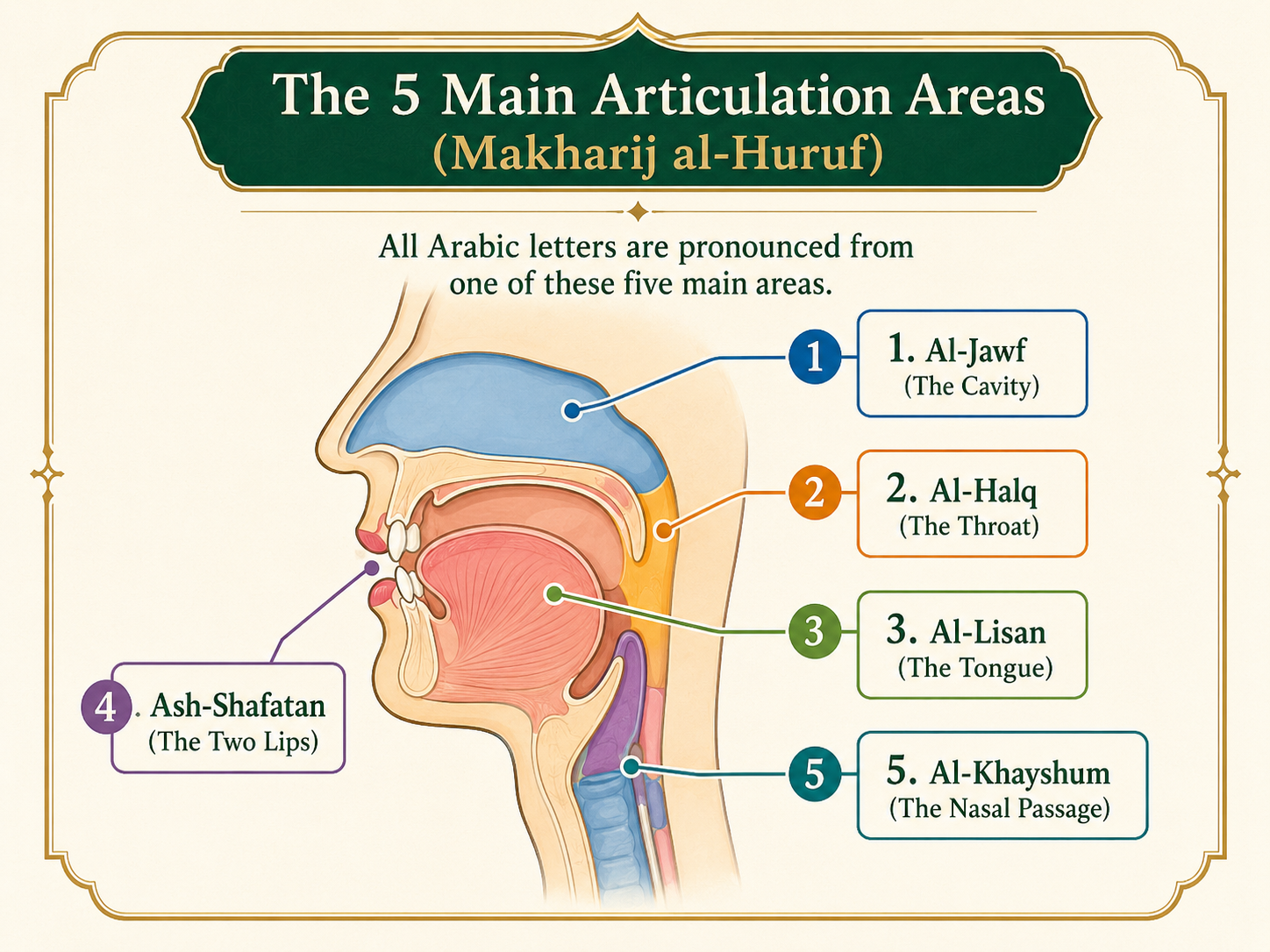
The 5 Main Articulation Areas
The articulation points of Arabic letters are organised under five main areas:
| Main area | Arabic name | General location |
|---|---|---|
| Oral cavity | Al-Jawf – الجوف | Empty space in the mouth and throat |
| Throat | Al-Halq – الحلق | Different sections of the throat |
| Tongue | Al-Lisan – اللسان | Different parts of the tongue and surrounding areas |
| Lips | Ash-Shafatan – الشفتان | One or both lips |
| Nasal passage | Al-Khayshum – الخيشوم | Nasal cavity used for Ghunnah |
Understanding these five areas first makes learning the individual Makharij of Arabic letters much easier.
1. Al-Jawf — الجوف
Al-Jawf refers to the open or empty space within the mouth and throat.
It is associated with the prolonged vowel sounds known as the letters of Madd.
These are:
- ا when it is preceded by a Fathah sound,
- و when it is preceded by a Dammah sound,
- ي when it is preceded by a Kasrah sound.
Unlike letters created through firm contact between the tongue, teeth, or lips, the Madd sound flows through the oral cavity.
Beginners should therefore learn to distinguish between a Madd letter and a normal consonantal و or ي, because their articulation is not treated in exactly the same way.
2. Al-Halq — الحلق
Al-Halq means the throat.
The reference material divides the throat into three sections, producing six throat letters.
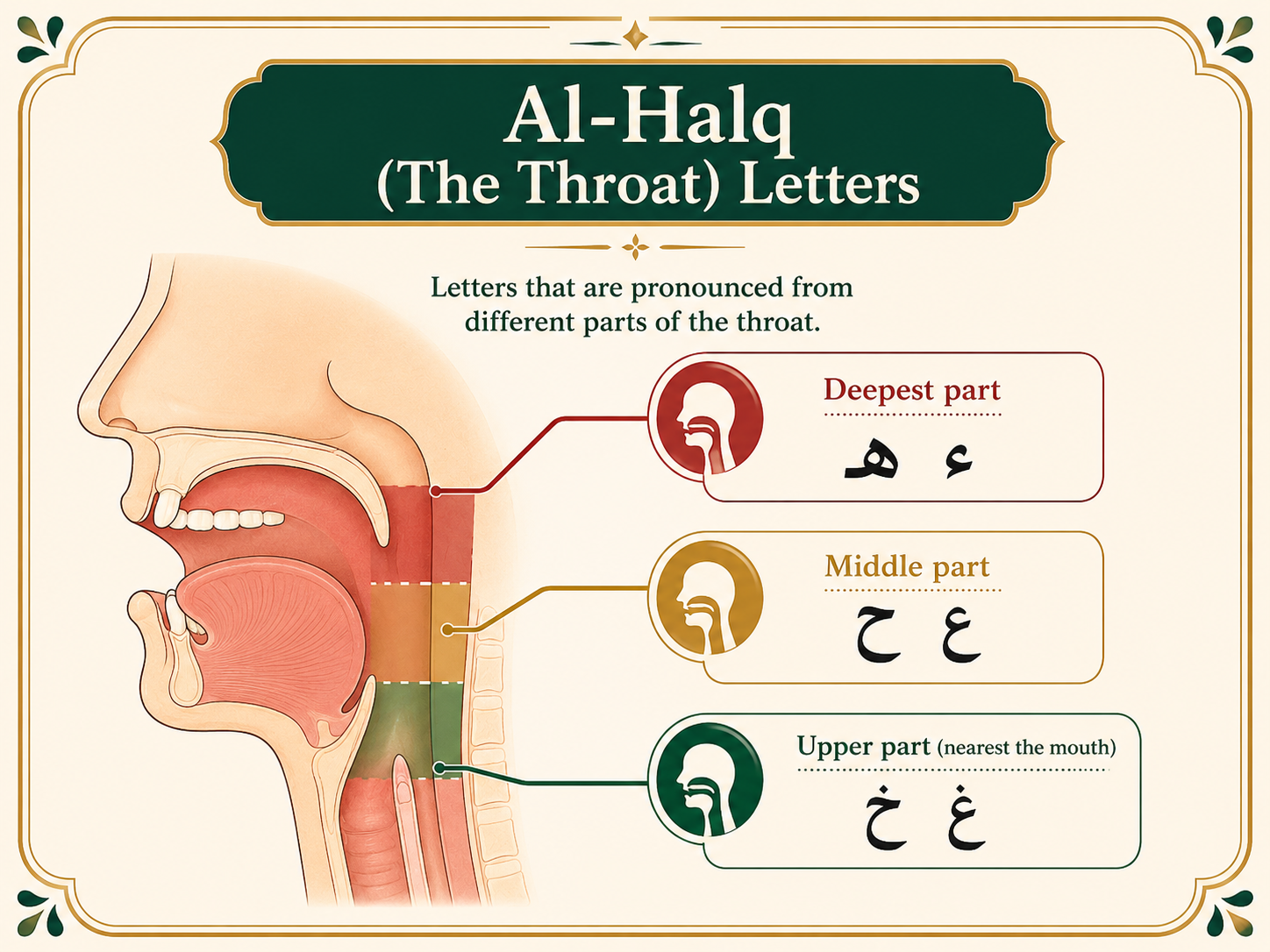
Deepest part of the throat
The letters are:
ء هـ
The sound begins from the deepest area of the throat.
Middle of the throat
The letters are:
ع ح
These are particularly difficult for many non-Arabic speakers because there are no exact English equivalents for their sounds.
Upper throat, nearest the mouth
The letters are:
غ خ
These are produced higher in the throat, closer to the mouth.
A simple way to remember the throat groups is:
| Throat area | Letters |
|---|---|
| Deepest | ء هـ |
| Middle | ع ح |
| Upper | غ خ |
The position of the throat matters. For example, pronouncing ح from the same area as ه removes an important distinction between the two letters.
3. Al-Lisan — اللسان
Al-Lisan, or the tongue, contains the largest number of Arabic articulation points.
Different letters may use the back, middle, side, edge, or tip of the tongue. The tongue may also interact with the palate or the teeth.
The reference groups several tongue letters according to their places of articulation, including:
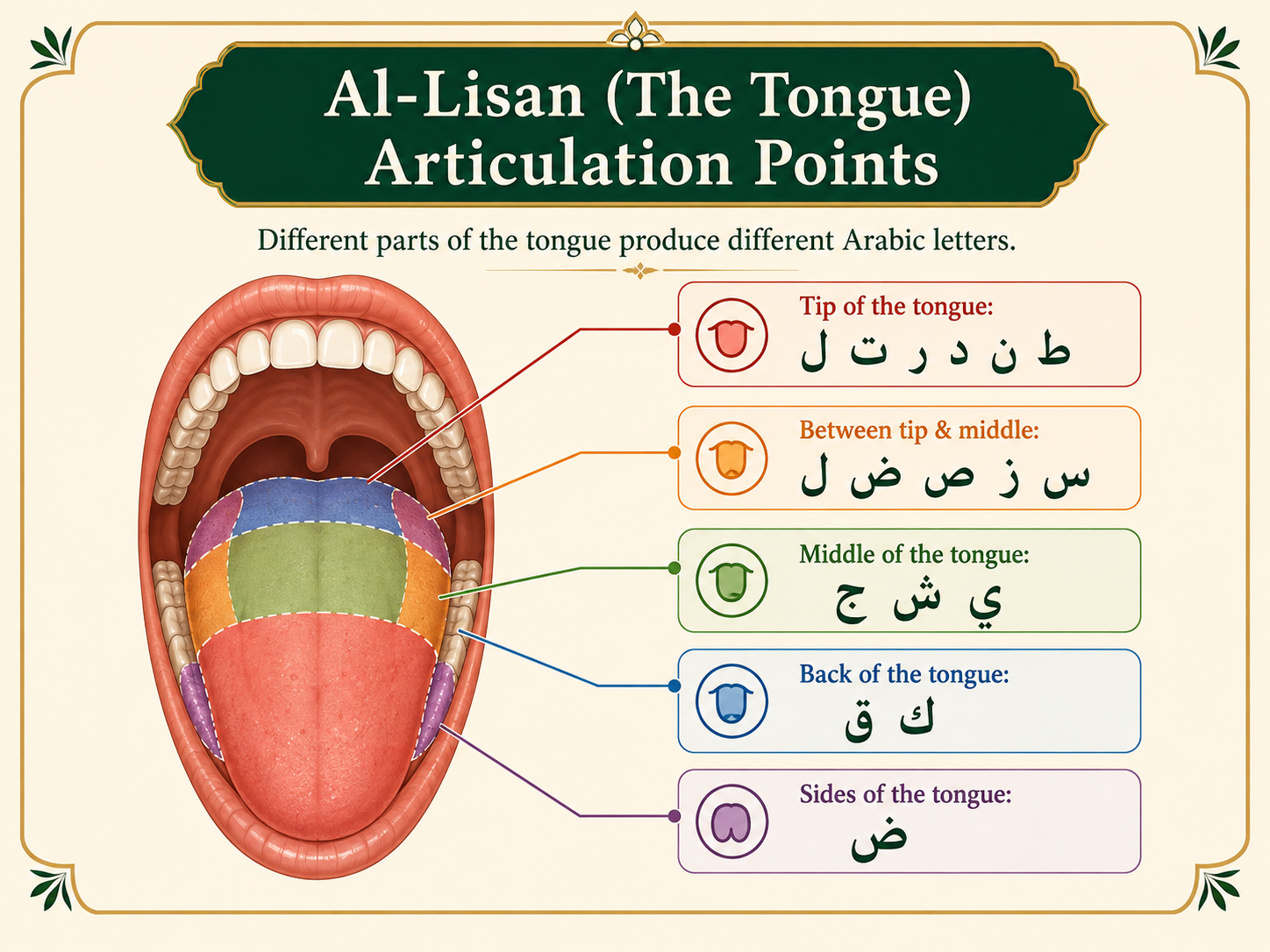
Qaf and Kaf — ق ك
Both involve the back part of the tongue, but ق is articulated farther back than ك.
This is why Qaf should not simply sound like a stronger English “k.”
Jeem, Sheen and Ya — ج ش ي
The reference groups:
ج ش ي
with articulation involving the middle area of the tongue.
For ي, students should remember that the consonantal Ya is different from the Ya used as a Madd letter.
Dad — ض
ض has a distinctive articulation involving the side of the tongue.
It is one of the Arabic letters that often requires considerable practice because beginners may replace it with د, ظ, or another similar sound.
Rather than forcing the sound, students should first learn the correct tongue position and then practise slowly.
Lam — ل
The letter ل uses the front portion and edge of the tongue in contact with the appropriate area behind the upper teeth.
Its articulation should remain clear rather than becoming overly heavy or weak.
Nun — ن
ن uses the tip area of the tongue.
Nun is also closely associated with Ghunnah, or nasal resonance, in the Tajweed situations where Ghunnah applies.
Ra — ر
For ر, the tongue approaches or contacts the area behind the upper front teeth.
A common beginner mistake is excessively rolling the letter. Quranic pronunciation requires control rather than turning the sound into a long repeated trill.
Ta, Dal and Taa — ت د ط
These letters share a closely related articulation area:
ت د ط
They involve the tip of the tongue and the area around the roots of the upper front teeth.
Although their Makhraj is closely related, their sound qualities are different. In particular, ط should not simply become an ordinary ت.
Tha, Dhal and Zaa — ث ذ ظ
The letters:
ث ذ ظ
are articulated using the tongue in relation to the upper front teeth.
Students often pull the tongue too far back, which can cause these letters to turn into other familiar sounds.
Sad, Zay and Seen — ص ز س
The letters:
ص ز س
are commonly grouped as Huroof-e-Safeer, because of the particular quality heard in their pronunciation.
A learner should especially take care not to pronounce ص exactly like س.
Learning the correct tongue placement first makes their differences much easier to hear.
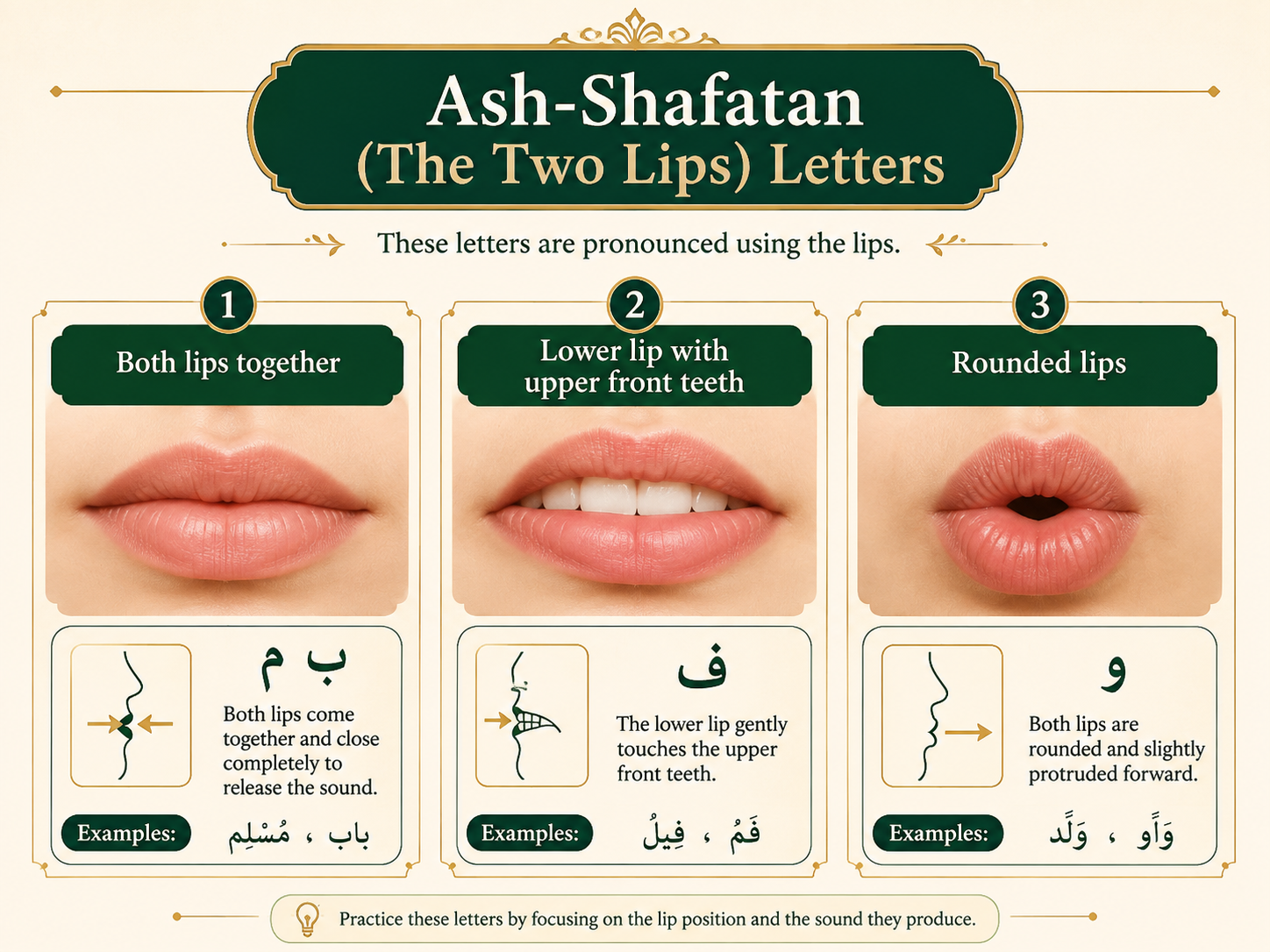
4. Ash-Shafatan — الشفتان
Ash-Shafatan means the two lips.
The reference identifies the lip-related letters as:
ف و ب م
However, they do not all use the lips in exactly the same way.
Fa — ف
ف is produced through interaction between the inside of the lower lip and the upper front teeth.
Beginners should avoid turning it into an overly strong English-style sound.
Ba — ب
For ب, the two lips meet.
The sound is released clearly without unnecessary exaggeration.
Meem — م
م is also produced with the two lips meeting.
When Ghunnah applies, nasal resonance accompanies the sound.
Waw — و
The consonantal و is produced through the lips, which become rounded without the same complete closure used for ب and م.
The consonantal Waw should also be distinguished from Waw Madd, which belongs to Al-Jawf.
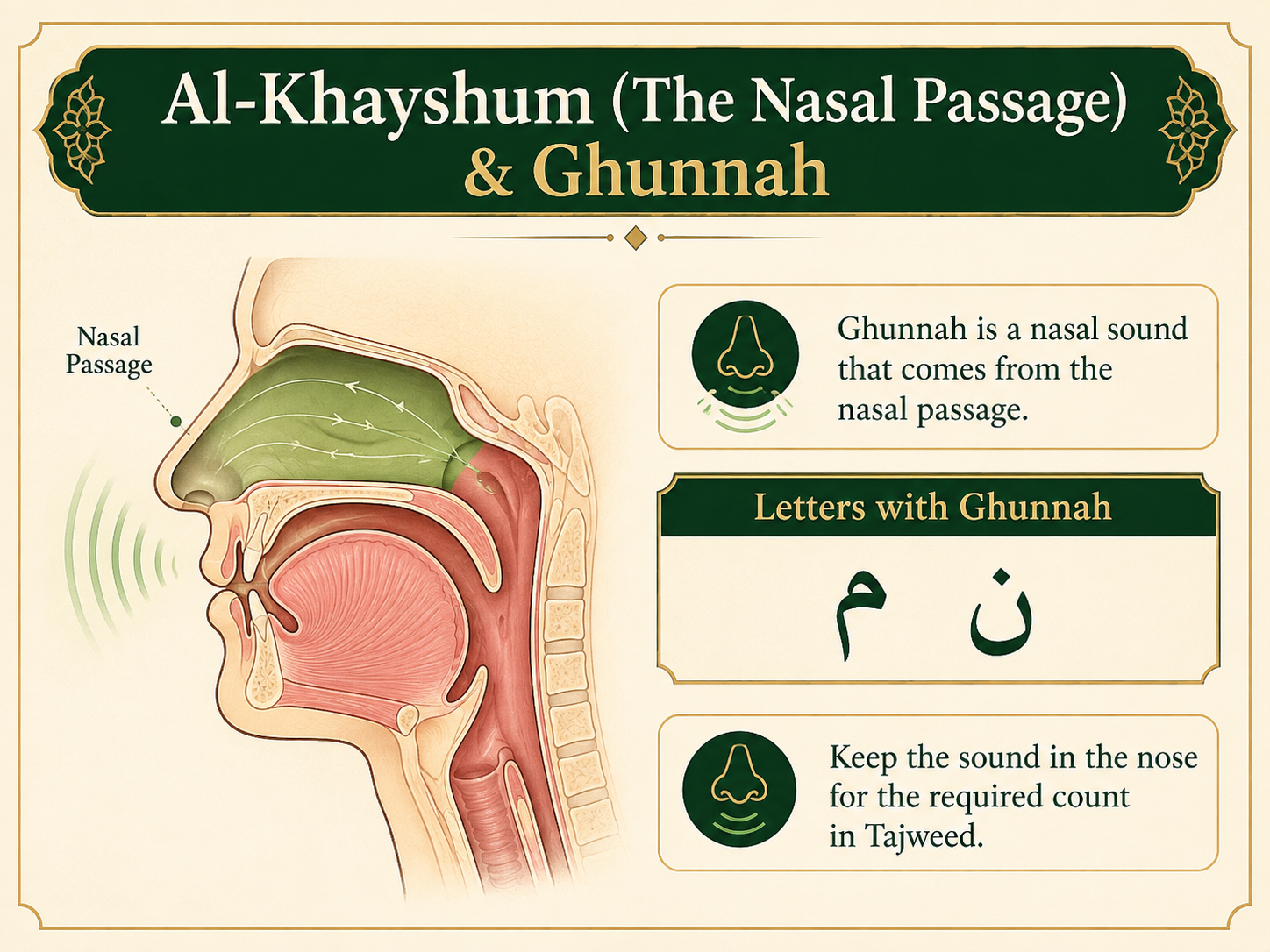
5. Al-Khayshum — الخيشوم
Al-Khayshum refers to the nasal passage.
It is the place associated with Ghunnah, the nasal sound connected especially with ن (Nun) and م (Meem) in the Tajweed situations where Ghunnah is required.
Ghunnah should come naturally through the nasal passage.
A useful way for beginners to understand it is to notice the resonance in the nose while producing the sound correctly. However, it should not be artificially exaggerated.
Correct Ghunnah is best learned by hearing and repeating it under a qualified teacher.
Commonly Confused Arabic Letters
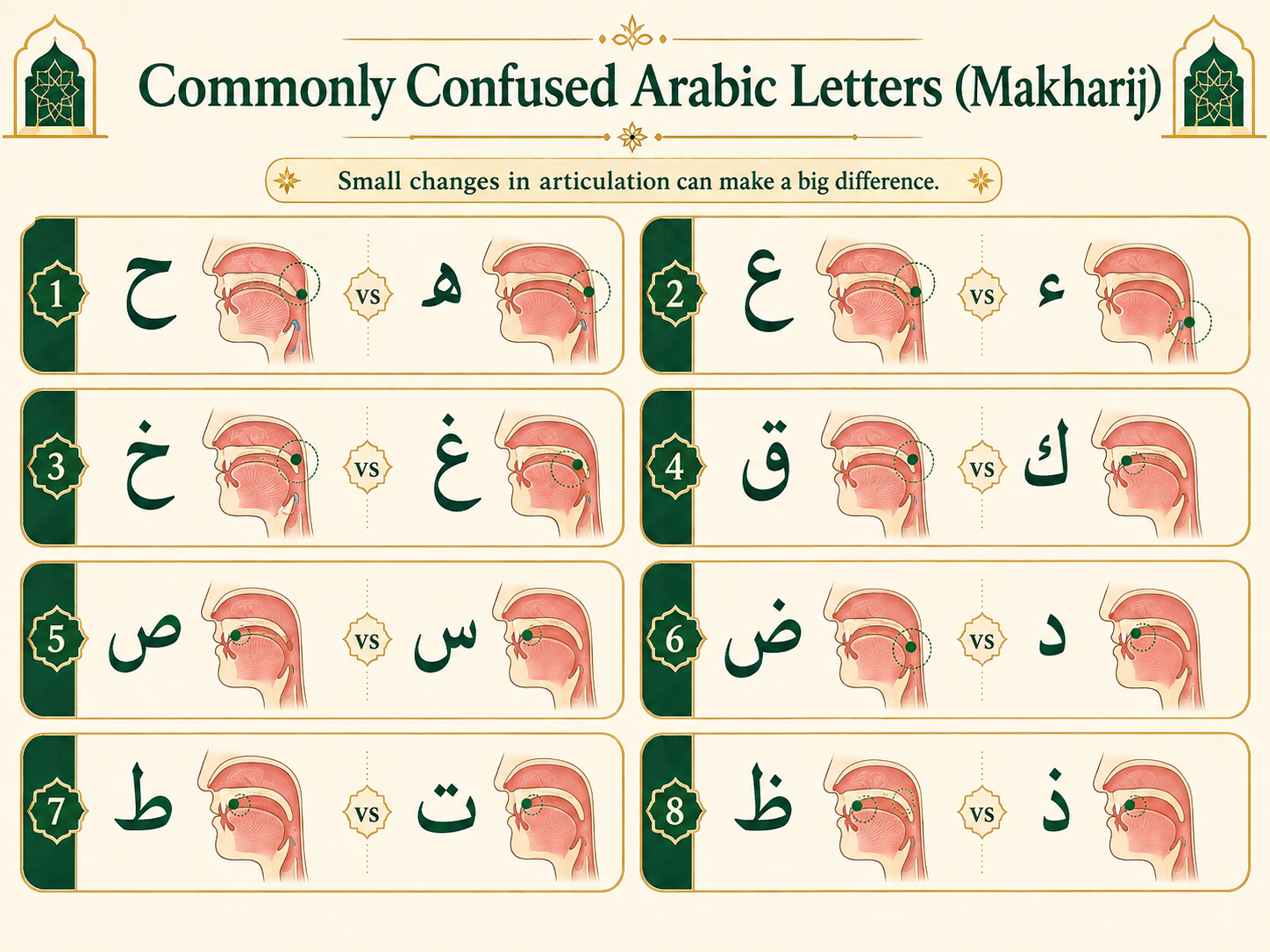
Some Arabic letter articulation points are very close to one another. This makes certain letters especially challenging for beginners.
ح and ه
Both are throat letters, but they originate from different sections.
ه comes from deeper in the throat, while ح comes from the middle throat.
ع and ء
Beginners sometimes replace ع with a simple vowel or Hamzah.
The letter ع must be articulated from the middle throat rather than omitted or replaced.
خ and غ
Both are produced from the upper throat.
The main goal for a beginner should be learning the correct position first and then listening carefully to the difference between them.
ق and ك
Both use the rear area of the tongue, but ق originates farther back.
Pronouncing both letters from the same point removes their distinction.
ص and س
س is lighter, while ص has a heavier quality.
The solution is not simply to make ص louder. Correct tongue placement and letter characteristics must work together.
ض and د
ض should not be reduced to د.
The articulation of Dad involves the side of the tongue and requires dedicated practice.
ط and ت
Both have closely related articulation points, but ط has qualities that make it heavier.
Simply adding more force to ت does not produce a correct ط.
ظ and ذ
These letters use a similar tongue-and-teeth area, but they must remain distinct in pronunciation.
Common Makharij Mistakes Beginners Make
Learning how to pronounce Arabic letters takes time. Some mistakes are particularly common among new students.
1. Pronouncing Arabic letters like English letters
Arabic has several sounds that do not have exact English equivalents.
Trying to force every Arabic letter into an English sound can lead to incorrect pronunciation.
2. Using the correct sound but the wrong articulation point
A learner may produce something that sounds approximately correct without positioning the tongue or throat properly.
This often becomes a problem when the letter appears in different words or combinations.
3. Confusing heavy and light letters
For example, س and ص, or ت and ط, should not sound identical.
4. Ignoring throat depth
The six throat letters come from three different throat areas. Producing them all from one general location can blur their differences.
5. Overworking difficult letters
Students sometimes strain the throat or tongue while trying to pronounce unfamiliar letters such as ع, ح, ض, or ق.
Correct articulation depends more on position and controlled practice than excessive force.
6. Learning only by reading descriptions
A diagram or written explanation can show you where a sound comes from, but pronunciation also needs to be heard.
Makharij is therefore both a theoretical and practical subject.
How Beginners Can Practise Makharij
You do not need to master every articulation point in one lesson.
A gradual approach usually works much better.
Start with the five main areas
First learn to recognise:
Jawf → Throat → Tongue → Lips → Nasal passage
Once these areas are familiar, individual letters become easier to organise mentally.
Practise related letters together
For example:
- ء هـ
- ع ح
- غ خ
- ق ك
- ج ش ي
- ت د ط
- ث ذ ظ
- ص ز س
- ف ب م و
Comparing neighbouring letters helps the ear notice their differences.
Use a mirror
A mirror can be useful when practising lip and tongue-related letters.
For letters such as ف, ب, م, و, ث, ذ, and ظ, observing the visible movement can help beginners understand what the teacher is explaining.
Practise slowly before reading quickly
Speed should come later.
Pronounce the letter individually first. Then practise it with short vowels and simple Quranic examples before trying to maintain the articulation during continuous recitation.
Listen carefully
Correct Quran pronunciation develops through both speaking and listening.
Pay attention to how a qualified reciter or Quran teacher pronounces difficult letters rather than relying only on transliteration.
Record yourself
Recording a short practice session can reveal differences that are difficult to notice while speaking.
Compare your pronunciation with your teacher's correction rather than simply judging whether it “sounds Arabic.”
Practise regularly
Ten focused minutes of Makharij practice every day can be more useful than occasionally practising for a long period.
Consistency helps the tongue become accustomed to unfamiliar positions.
Why Learning Makharij With a Qualified Quran Teacher Helps
Books, diagrams, recordings, and online guides can explain Tajweed Makharij, but there is one difficulty: a learner may not always hear their own mistake.
You might believe that your ق is different from ك, for example, while an experienced teacher can immediately hear that both are being pronounced from almost the same place.
A qualified Quran teacher can:
- demonstrate the correct articulation,
- watch or listen to how you produce a letter,
- identify exactly where your pronunciation is changing,
- correct mistakes before they become habits,
- provide suitable repetition exercises, and
- gradually apply Makharij rules to actual Quran recitation.
This personalised correction is especially valuable for children and non-Arabic-speaking adults who are encountering some Arabic sounds for the first time.
Frequently Asked Questions About Makharij al-Huruf
What is Makharij al Huruf?
Makharij al-Huruf refers to the articulation points from which Arabic letters are pronounced. These articulation points are located in areas such as the throat, tongue, lips, oral cavity, and nasal passage.
What does Makhraj mean?
Makhraj means an exit point or place of emergence. In Tajweed, it refers to the specific location from which the sound of an Arabic letter is produced.
Makharij is the plural of Makhraj.
What are the five main Makharij areas?
The five main areas are:
- Al-Jawf — oral cavity
- Al-Halq — throat
- Al-Lisan — tongue
- Ash-Shafatan — lips
- Al-Khayshum — nasal passage
Which Arabic letters come from the throat?
The six throat letters are:
ء هـ ع ح غ خ
They are divided among the deepest, middle, and upper sections of the throat.
Which letters are pronounced with the lips?
The principal lip-related letters discussed in Makharij are:
ف ب م و
Fa involves the lower lip and upper teeth, while Ba, Meem, and consonantal Waw use the lips in different ways.
Is Makharij part of Tajweed?
Yes. Learning correct articulation is a fundamental part of Tajweed because Tajweed requires each Arabic letter to be pronounced correctly and distinctly.
For a broader introduction, you can also read “What Is Tajweed? Definition, Purpose, and Importance in Islam.”
Can I learn Makharij by myself?
You can learn the basic theory through diagrams, videos, and written lessons. However, pronunciation is much easier to correct with a qualified teacher who can hear mistakes that you may not notice yourself.
How long does it take to learn Makharij?
There is no single timeframe for every student. Some articulation points may become comfortable quickly, while unfamiliar letters such as ع, ح, ض, غ, خ, or ق may require additional practice.
The aim should be steady improvement rather than rushing through all the letters.
Build a Strong Foundation in Quran Pronunciation
Learning Makharij al Huruf gives Quran students a practical foundation for accurate pronunciation.
Instead of guessing how an Arabic letter should sound, you begin to understand where the sound originates and how the tongue, throat, lips, or nasal passage should be used.
For beginners, the best approach is simple: learn one articulation area at a time, listen carefully, practise consistently, and allow your teacher to correct you.
At As Sadiq Shia Online Quran Academy, children and adults can learn Quran recitation and Tajweed with guided instruction suited to their current level. Whether you are beginning Arabic pronunciation or want to improve an existing recitation, structured lessons can help you develop your Makharij gradually and confidently.
Explore the academy's Quran and Tajweed classes to begin learning with a qualified teacher.