
Tajweed · Beginner Guide
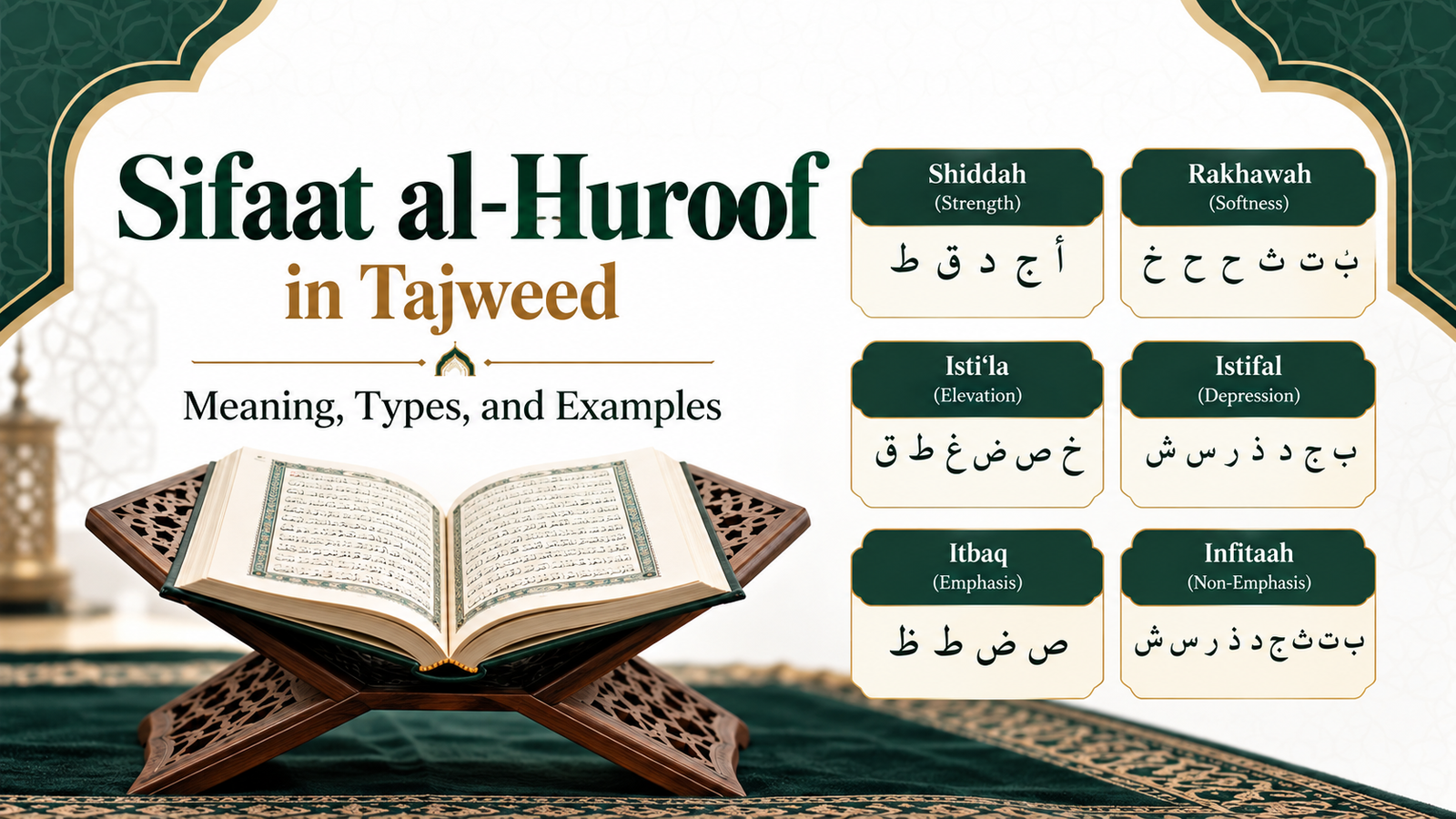
Correct Quran recitation requires more than knowing the Arabic alphabet. Every Arabic letter has unique characteristics that affect how it is pronounced. In Tajweed, these qualities are called Sifaat al-Huroof.
Understanding these characteristics helps learners pronounce letters accurately, distinguish similar sounds, and improve their Quran recitation. In this guide, we will explore their meaning, main types, and examples in simple terms.
What Is Sifaat al-Huroof in Tajweed?
Sifaat al-Huroof (صِفَاتُ الْحُرُوفِ) means the characteristics or qualities of Arabic letters. In Tajweed, Sifaat describes how a letter sounds when pronounced from its correct articulation point.
For example, some letters allow breath to flow freely, while others restrict it. Some letters have a heavy sound, while others are pronounced lightly. Learning these differences helps students recite the Quran with greater clarity and accuracy.
Why Is Sifaat al-Huroof Important?
Sifaat al-Huroof helps learners:
- Pronounce Arabic letters correctly.
- Distinguish between similar-sounding letters.
- Understand heavy and light pronunciation.
- Control breath and sound while reciting.
- Avoid common Tajweed mistakes.
For example, ت (Ta) is pronounced lightly, while ط (Taa) has a heavy, emphatic sound. Understanding their characteristics makes the difference easier to recognise.
Difference Between Makharij and Sifaat al-Huroof
Makharij al-Huroof refers to where a letter is pronounced, while Sifaat al-Huroof explains how the letter sounds.
| Makharij al-Huroof | Sifaat al-Huroof |
|---|---|
| Articulation points of letters | Characteristics of letters |
| Explains where sounds originate | Explains how sounds are produced |
| Example: ب comes from both lips | Example: ب has Shiddah and Jahr |
Both subjects work together to improve Arabic pronunciation.
Main Types of Sifaat al-Huroof
In a commonly taught Tajweed classification, Sifaat are divided into two main categories:
- Sifaat with opposites: Characteristics arranged in contrasting groups.
- Sifaat without opposites: Characteristics that have no directly corresponding opposite.
Some Tajweed teaching traditions count or organise these qualities differently.
1. Sifaat with Opposites
There are five main groups of contrasting characteristics.
Hams and Jahr
Hams (الْهَمْس) means breath flows during pronunciation. The ten Hams letters are:
ف ح ث ه ش خ ص س ك ت
Example: س (Seen) allows air to flow during pronunciation.
Jahr (الْجَهْر) means breath is restricted during articulation. Examples include ب، د، ج، ز، ع.
Shiddah, Tawassut, and Rikhawah
These characteristics describe how sound is restricted or allowed to flow.
- Shiddah: Complete restriction of sound. Letters: ء ج د ق ط ب ك ت.
- Tawassut: Intermediate sound flow. Letters: ل ن ع م ر.
- Rikhawah: Continuous sound flow. Examples: س، ش، ف، خ.
For example, ب involves a brief closure, while س produces a continuous sound.
Isti'la and Istifal
Isti'la (الِاسْتِعْلَاء) involves raising the back of the tongue toward the upper palate, contributing to heavy pronunciation. Its seven letters are:
خ ص ض غ ط ق ظ
Istifal (الِاسْتِفَال) involves lowering the tongue away from the upper palate. Most Istifal letters are pronounced lightly, although certain letters follow additional pronunciation rules.
Itbaq and Infitah
Itbaq (الْإِطْبَاق) produces a compressed quality of articulation. Its four letters are:
ص ض ط ظ
Infitah (الِانْفِتَاح) is the opposite characteristic and applies to the remaining letters.
Idhlaq and Ismat
Idhlaq (الْإِذْلَاق) is a traditional classification associated with letters articulated using the tongue tip or lips. Its six letters are:
ف ر م ن ل ب
Ismat (الْإِصْمَات) includes the remaining letters. These categories are mainly useful for understanding classical Arabic letter classification rather than producing a separate audible effect.
2. Sifaat Without Opposites
These are special characteristics associated with particular Arabic letters.
| Characteristic | Letters | Meaning |
|---|---|---|
| Qalqalah | ق ط ب ج د | Controlled bouncing or echo-like release |
| Safeer | ص ز س | Whistle-like sound |
| Leen | و ي | Soft pronunciation when Sakin and preceded by Fathah |
| Inhiraf | ل ر | Deviation of articulation or sound |
| Takreer | ر | Natural tendency toward tongue-tip repetition |
| Tafashshi | ش | Spreading of sound |
| Istitalah | ض | Extension of articulation along the tongue |
Understanding Qalqalah
Qalqalah is one of the most commonly practised characteristics. It occurs when one of the five Qalqalah letters carries Sukoon or becomes Sakin when stopping.
- خَلَقْنَا: Qalqalah occurs on ق.
- يَجْعَلُ: Qalqalah occurs on ج.
- أَحَدٌ: When stopping, the final د is pronounced with Qalqalah.
The sound should be clear without adding an extra vowel. Learn more in our article: Qalqalah in Tajweed: Letters, Rules, and Examples.
Note: Some Tajweed curricula also classify Ghunnah (nasal resonance) as a separate characteristic associated with ن and م.
Simple Sifaat al-Huroof Examples for Beginners
Here are a few examples to help you understand how letter characteristics affect pronunciation.
| Arabic letter | Characteristic | Practice tip |
|---|---|---|
| س | Hams, Safeer | Allow the natural hissing sound |
| ب | Shiddah, Jahr | Close both lips and release clearly |
| ص | Isti'la, Itbaq | Maintain its emphatic quality |
| ش | Tafashshi | Allow sound to spread naturally |
| ر | Takreer | Avoid excessive rolling |
| ض | Istitalah | Practise its distinctive tongue articulation |
A single Arabic letter may possess several characteristics at the same time.
Common Mistakes When Learning Sifaat al-Huroof
- Confusing heavy and light letters: Pronouncing س and ص in the same way.
- Exaggerating Qalqalah: Adding an unnecessary vowel or excessive bounce.
- Rolling Ra excessively: Repeating ر more than necessary.
- Mispronouncing Daad: Replacing ض with د, ز, or ظ.
- Memorising without practice: Learning definitions without listening to correct pronunciation.
Listening to a qualified reciter and practising with a Tajweed teacher can help correct these mistakes.
How to Practise Sifaat al-Huroof
- Learn Makharij first: Understand where each Arabic letter originates.
- Compare similar letters: Practise ت and ط or س and ص to recognise pronunciation differences.
- Practise with Sukoon: Use exercises such as أَسْ and أَبْ to observe sound characteristics.
- Listen and repeat: Follow a qualified Quran reciter and repeat short examples.
- Get teacher feedback: Correct your pronunciation through guided practice.
Consistent practice is more important than trying to memorise every characteristic immediately.
Learn Tajweed at As Sadiq Shia Online Quran Academy
Sifaat al-Huroof is an essential part of understanding correct Arabic pronunciation. By learning the characteristics of letters, students can develop clearer Quran recitation and avoid common mistakes.
At As Sadiq Shia Online Quran Academy, we offer online Quran and Tajweed lessons from a Shia Islamic perspective. Students can learn step by step with guidance suited to their experience level.
Whether you are a beginner or want to improve your recitation, structured Tajweed lessons can help you progress with confidence.
Explore our Tajweed classes or contact us to start a free trial class.