
Tajweed · Beginner Guide
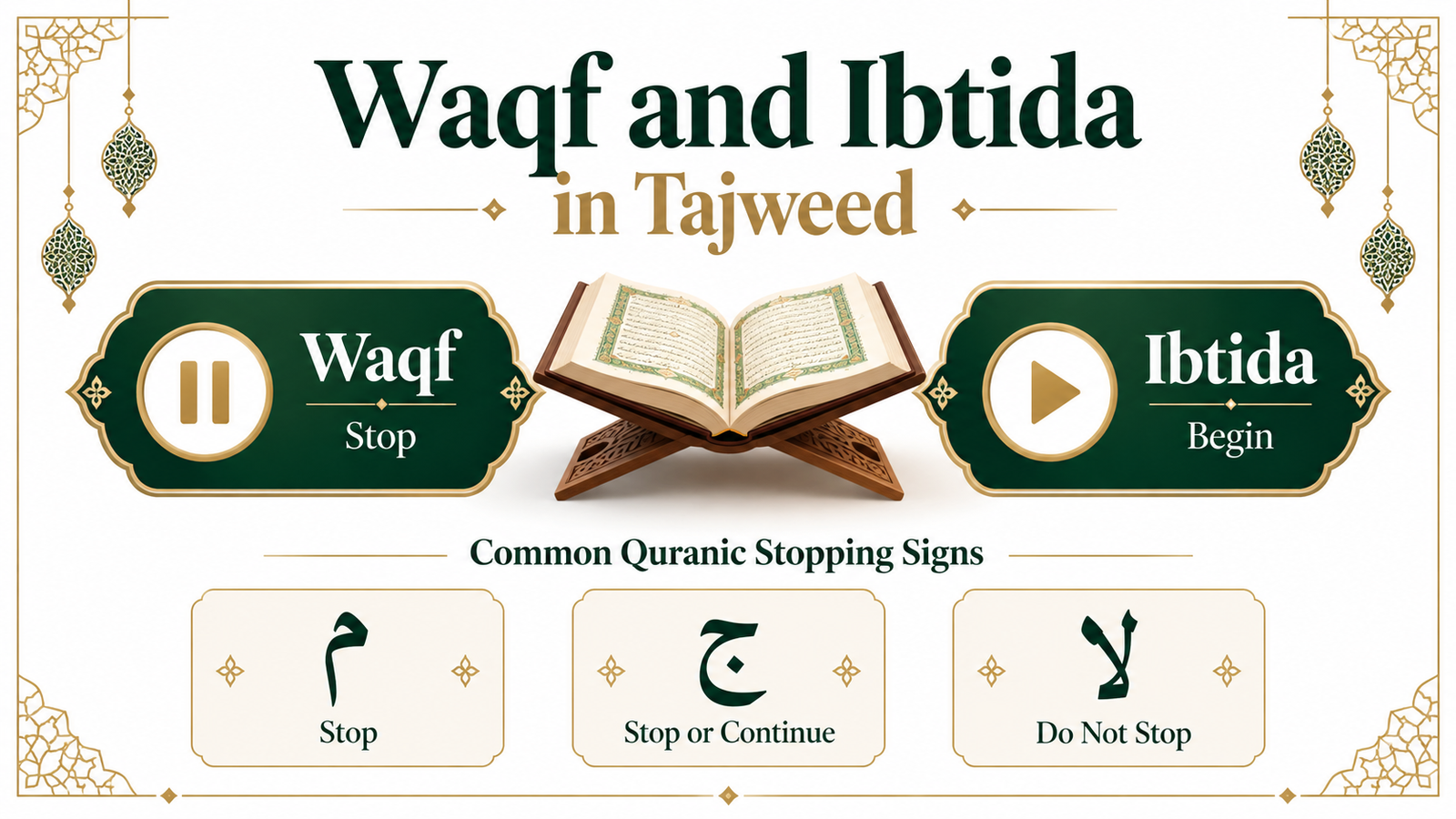
When reciting the Holy Quran, knowing where to stop and where to begin again is just as important as pronouncing Arabic letters correctly. A pause in the wrong place can interrupt the meaning of a verse or make the recitation difficult to understand.
In Tajweed, the rules that guide stopping and restarting are known as Waqf and Ibtida. These rules help readers maintain the intended meaning of Quranic verses, manage their breathing, and recite with greater clarity.
In this beginner-friendly guide, you will learn the meaning of Waqf and Ibtida, their main types, common Quranic stopping signs, and practical ways to apply them during recitation.
What Are Waqf and Ibtida in Tajweed?
Waqf and Ibtida (الْوَقْفُ وَالِابْتِدَاءُ) are two closely related principles of Quran recitation.
What Is Waqf?
Waqf (وَقْف) means stopping or pausing during Quran recitation. In Tajweed, Waqf refers to stopping the sound at the end of a word, normally taking a breath, and intending to continue reciting.
For example, at the end of the opening verse of Surah Al-Fatihah:
بِسْمِ اللَّهِ الرَّحْمَٰنِ الرَّحِيمِ
A reader may stop after الرَّحِيمِ before continuing to the next verse. When stopping, the final letter is pronounced according to the applicable Waqf rules rather than simply retaining its normal connecting vowel.
What Is Ibtida?
Ibtida (ابْتِدَاء) means beginning or starting recitation. In Tajweed, it refers to starting Quran recitation or resuming after a pause from a suitable word that preserves the intended meaning.
For example, after stopping at the end of the opening verse of Surah Al-Fatihah, the reader may begin with:
الْحَمْدُ لِلَّهِ رَبِّ الْعَالَمِينَ
(Surah Al-Fatihah 1:2 in the verse numbering used here.) The purpose of Ibtida is to begin from a meaningful point rather than starting in the middle of an incomplete expression.
Why Are Waqf and Ibtida Important?
Correct stopping and starting help maintain the meaning and clarity of Quran recitation. Learning these rules allows students to:
- Preserve the intended meaning of Quranic verses.
- Avoid stopping between closely connected words.
- Recognise Quranic stopping signs.
- Manage breathing during longer verses.
- Resume recitation from appropriate words.
- Improve fluency and confidence in Tajweed.
For example, in Surah Al-Fatihah:
الْحَمْدُ لِلَّهِ رَبِّ الْعَالَمِينَ
This means, approximately, “All praise belongs to Allah, Lord of the worlds.” Stopping after الْحَمْدُ leaves the expression incomplete. A learner who needs to pause there should restart from a suitable point, such as the beginning of the verse.
Main Types of Waqf in Tajweed
Tajweed scholars commonly describe four types of Waqf based on completeness of meaning and connection to the following words.
1. Waqf Tamm (Complete Stop)
Waqf Tamm (الْوَقْفُ التَّامُ) refers to stopping where the meaning is complete and does not depend grammatically or directly in meaning on the following words. It is generally a suitable place to pause and begin a new passage. Stopping at the end of a completed Surah before beginning another is a straightforward example.
2. Waqf Kafi (Sufficient Stop)
Waqf Kafi (الْوَقْفُ الْكَافِي) occurs when the meaning is complete in itself, but the following words are still connected in subject or meaning. Stopping is generally acceptable, and recitation can begin from the following suitable phrase.
3. Waqf Hasan (Good Stop)
Waqf Hasan (الْوَقْفُ الْحَسَنُ) occurs when the recited words form a meaningful expression, but what follows is closely connected grammatically or contextually. Stopping may be acceptable, especially when necessary, but restarting directly from the next word may not be suitable. The reader may need to repeat a few words.
4. Waqf Qabih (Improper Stop)
Waqf Qabih (الْوَقْفُ الْقَبِيحُ) refers to stopping at a point that leaves the meaning incomplete, confusing, or misleading.
For example, stopping after لَا إِلَٰهَ in the declaration لَا إِلَٰهَ إِلَّا اللَّهُ leaves an incomplete statement. The full expression means “There is no deity except Allah.” This is a meaning example, not a citation of a particular Quranic verse.
If you must stop at an unsuitable place because of breath or another necessity, restart from an earlier meaningful point.
Note: These four categories describe the quality of a stopping place. They are not identical to the printed stopping signs in a Mushaf.
Common Quranic Stopping Signs and Their Meanings
You may notice small Arabic signs above words in the Quran. These Waqf signs help readers recognise where stopping is preferred, permitted, or discouraged.
| Symbol | Name | How to respond |
|---|---|---|
| م | Waqf Lazim | Stop here to preserve the intended meaning. |
| لا | La Waqf | Avoid stopping here. |
| ج | Waqf Jaiz | Stopping or continuing is allowed. |
| قلى | Waqf Awla | Stopping is preferred. |
| صلى | Wasl Awla | Continuing is preferred. |
| ∴ ∴ | Waqf Mu'anaqah | Stop at one of the paired places, not both in the same reading. |
Additional Signs Found in Some Mushafs
- ط (Waqf Mutlaq): A suitable stopping point, generally with stopping preferred.
- ز (Waqf Mujawwaz): Stopping is allowed, although continuing is generally preferred.
- ص (Waqf Murakhkhas): A permitted stop when needed, often because of breath.
- قف (Qif): A recommendation to stop in the relevant notation system.
A small س or Saktah sign can indicate a brief pause without taking a breath, which differs from ordinary Waqf.
Important: Stopping signs are scholarly reading aids rather than words of the Quran. Their selection, placement, and terminology can differ across Mushaf editions, including Madinah and Indo-Pak editions. Follow the convention of your Mushaf and your teacher.
Quranic Examples of Waqf and Ibtida
Example 1: Stopping at the End of a Verse
Surah Al-Ikhlas (112:1):
قُلْ هُوَ اللَّهُ أَحَدٌ
When stopping at the end of this verse, the final د becomes Sakin and is pronounced with Qalqalah. For further practice, read our Qalqalah in Tajweed guide.
Example 2: Choosing Between Two Stopping Places
Surah Al-Baqarah (2:2):
ذَٰلِكَ الْكِتَابُ لَا رَيْبَ فِيهِ هُدًى لِلْمُتَّقِينَ
Some Mushaf editions mark paired stopping places around لَا رَيْبَ فِيهِ. A reader can stop after لَا رَيْبَ or after فِيهِ, according to the printed signs. When following the paired-stop rule, do not stop at both positions in the same reading.
Example 3: Restarting from a Meaningful Point
Surah Al-Fatihah (1:5):
إِيَّاكَ نَعْبُدُ وَإِيَّاكَ نَسْتَعِينُ
The verse means, approximately, “You alone we worship, and You alone we ask for help.” If you stop after إِيَّاكَ, the expression remains incomplete. Restarting from إِيَّاكَ نَعْبُدُ preserves the meaning.
How to Pronounce the Last Letter When Stopping
1. Stopping with Sukoon
In many cases, the final short vowel is dropped and the last letter becomes Sakin.
نَسْتَعِينُ ← نَسْتَعِينْ
This is the stopping pronunciation at the end of Surah Al-Fatihah (1:5).
2. Stopping on Tanween Fathah
When stopping on a word ending in Tanween Fathah (ـً), the ending is generally pronounced with a two-count Alif sound, subject to exceptions.
عَلِيمًا ← عَلِيمَا
3. Stopping on Ta Marbutah
When stopping on Ta Marbutah (ة), it is normally pronounced as a Sakin Haa.
رَحْمَةٌ ← رَحْمَهْ
These basic rules help learners avoid retaining ordinary connecting vowels when stopping. Advanced methods, including Rawm and Ishmam, are best learned with a qualified teacher.
Rules of Ibtida: How to Start Recitation Correctly
Start from a Complete Meaning
Choose a word or phrase that forms a meaningful beginning. Avoid starting from words that depend on an earlier phrase to make sense.
Repeat Words When Necessary
If you stop in the middle of a connected expression because you run out of breath, go back to a suitable earlier point before continuing.
Understand the Difference Between Waqf and Ibtida
A stopping place may be acceptable even when the next word is not suitable as an independent starting point. That is why students should practise both where to stop and where to resume.
Common Mistakes Beginners Make
- Stopping at an incomplete phrase: Pausing before the intended meaning becomes clear.
- Ignoring stopping signs: Missing indications that stopping is recommended or discouraged.
- Restarting from an unsuitable word: Beginning with a word that depends on what came before.
- Pronouncing final vowels while stopping: Forgetting that word endings often change at Waqf.
- Confusing Waqf with Saktah: Treating a brief pause without breath as an ordinary stop.
Practical Tips to Improve Waqf and Ibtida
- Learn the common signs: Begin with م، لا، ج، قلى، صلى.
- Practise short Surahs: Start with Surah Al-Fatihah and Surah Al-Ikhlas.
- Pay attention to meaning: Read a reliable translation to understand complete phrases.
- Plan your breathing: Avoid rushing through long passages without suitable pauses.
- Listen and repeat: Observe how qualified reciters stop and resume.
- Ask for feedback: Let a Tajweed teacher correct difficult stops and starting points.
Learn Waqf and Ibtida with As Sadiq Shia Online Quran Academy
Waqf and Ibtida are important parts of correct Quran recitation. Understanding when to stop, where to begin again, and how to follow Quranic stopping signs helps students read with greater clarity and confidence.
At As Sadiq Shia Online Quran Academy, we provide online Quran and Tajweed classes from a Shia Islamic perspective. Lessons help students strengthen pronunciation, understand Tajweed rules, and improve recitation through guided practice.
Explore our Tajweed classes or contact us to arrange a free trial class.