
Tajweed · Beginner Guide
Learning Tajweed becomes much easier when you understand how certain letters change depending on what comes after them. One of the most important examples is Noon Sakin and Tanween.
Both produce an “n” sound, but that sound is not always pronounced in the same way. Depending on the next letter, it may be pronounced clearly, merged into another letter, changed into a different sound, or partially hidden.
These are known as the four rules of Noon Sakin and Tanween:
Izhar, Idgham, Iqlab, and Ikhfa.
For beginners, these names may seem difficult at first. However, once you learn which letters belong to each rule and practise them with a teacher, identifying them in the Quran becomes much easier.
This guide explains each rule in simple English with Arabic letters and clear Quranic examples.
What Is Noon Sakin?
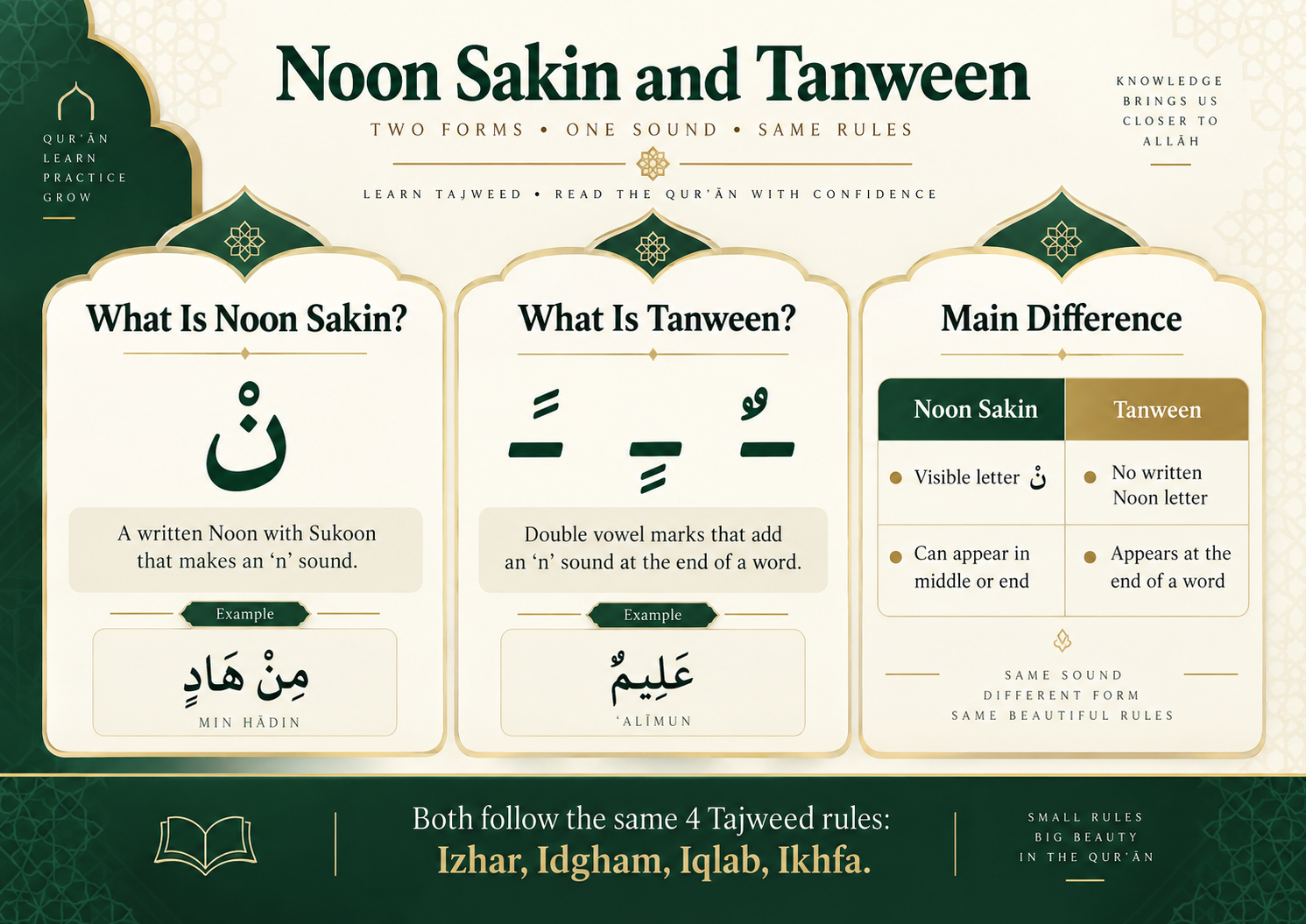
Noon Sakin, also called Noon Saakinah (النون الساكنة), is the Arabic letter ن carrying a Sukoon:
نْ
A Sukoon means that the letter has no short vowel after it. Therefore, Noon Sakin produces a simple “n” sound.
For example:
مِنْ هَادٍ
The Noon in مِنْ has a Sukoon: نْ.
Another example is:
مِنْ شَرِّ
Again, the Noon is written with a Sukoon.
Noon Sakin can appear in the middle of a word or at the end of a word. The way it is pronounced depends on the letter that follows it.
That is why learning the Noon Sakin rules is an important part of beginner Tajweed.
What Is Tanween?
Tanween (التنوين) is a double vowel mark that appears at the end of a word. It creates an extra “n” sound even though the letter ن is not actually written.
There are three forms of Tanween:
| Tanween | Name | Approximate Sound |
|---|---|---|
| ـً | Fathatain | “an” |
| ـٍ | Kasratain | “in” |
| ـٌ | Dammatain | “un” |
For example:
عَلِيمٌ
The ending ـٌ produces an “un” sound.
Another example is:
عَلِيمًا
The ـً produces an “an” sound when continuing the recitation.
Tanween therefore acts like an extra Noon sound in pronunciation. This is why the same four Tajweed rules that apply to Noon Sakin also apply to Tanween.
Difference Between Noon Sakin and Tanween
Although Noon Sakin and Tanween can produce a similar “n” sound, they are written differently.
| Noon Sakin | Tanween |
|---|---|
| An actual letter نْ is written | No Noon letter is written |
| Can appear in the middle or at the end of a word | Appears at the end of a word |
| Written as Noon with Sukoon | Written as double vowel marks |
| Example: مِنْ | Example: عَلِيمٌ |
The easiest way for a beginner to remember the difference is this:
Noon Sakin contains a visible Noon, while Tanween gives the sound of Noon without writing the letter Noon.
Despite this difference, both follow the same four Tajweed rules when another letter comes after them.
The 4 Rules of Noon Sakin and Tanween
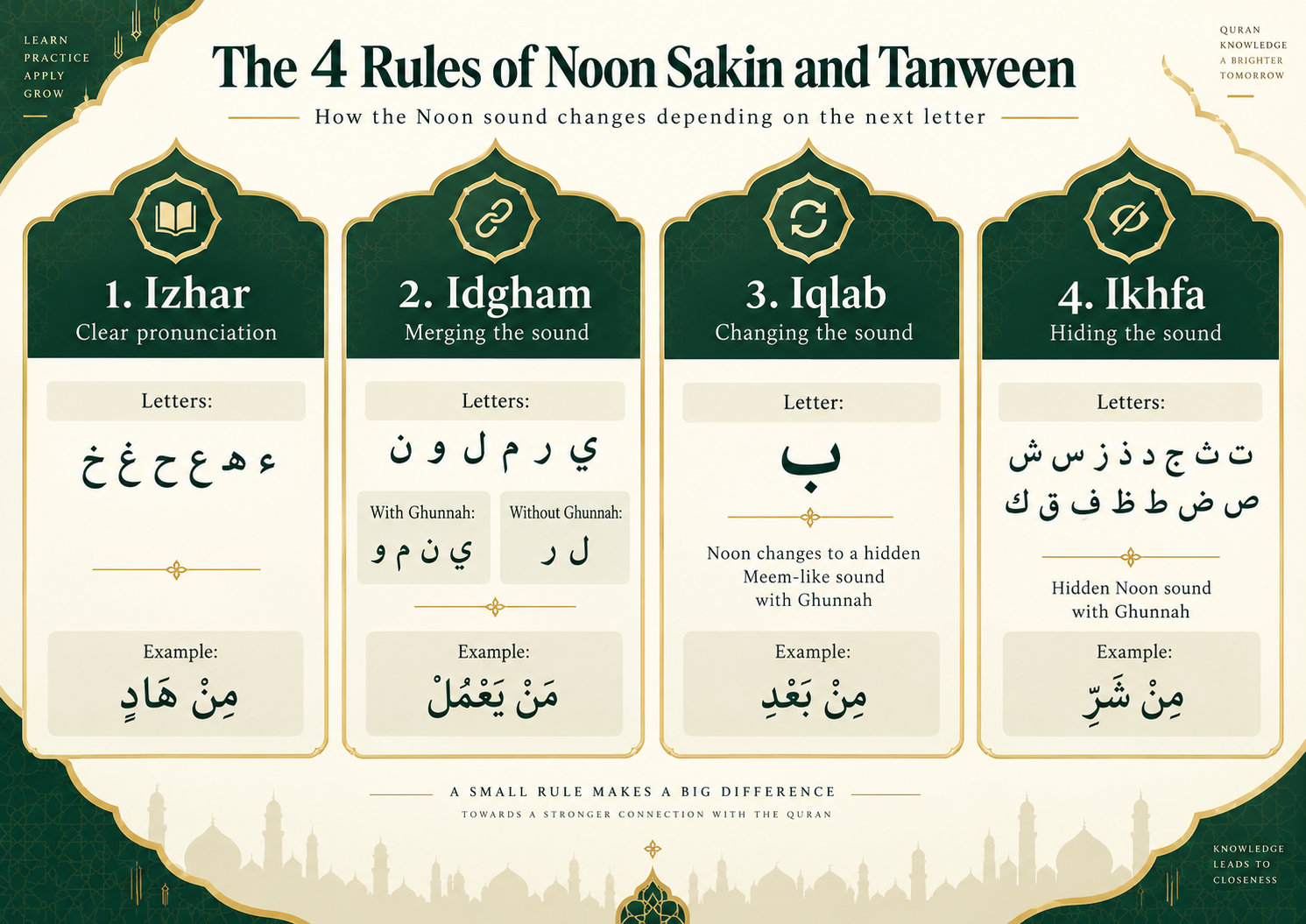
The rule you apply depends mainly on the letter immediately after Noon Sakin or Tanween.
The four rules are:
Izhar → Idgham → Iqlab → Ikhfa
Let us understand each one separately.
1. Izhar – Clear Pronunciation
Izhar (الإظهار) means to make clear or to pronounce clearly.
Izhar occurs when Noon Sakin or Tanween is followed by one of the six throat letters.
The Six Izhar Letters
ء هـ ع ح غ خ
| Arabic Letter | Name |
|---|---|
| ء | Hamzah |
| هـ | Haa |
| ع | ‘Ayn |
| ح | Haa |
| غ | Ghayn |
| خ | Khaa |
How Is Izhar Pronounced?
When one of these letters comes after Noon Sakin or Tanween, pronounce the Noon sound clearly and separately.
Do not merge it into the next letter and do not hide the Noon sound.
For example:
مِنْ هَادٍ
Here, Noon Sakin is followed by هـ, so the Noon is pronounced clearly.
Another example:
مَنْ آمَنَ
The Noon is followed by ء, which is an Izhar letter.
With Tanween:
عَلِيمٌ حَكِيمٌ
The Tanween is followed by ح, so its “n” sound is pronounced clearly before moving to the next letter.
If Noon Sakin or Tanween meets one of the six throat letters, make the Noon sound clear.
2. Idgham – Merging the Sound
Idgham (الإدغام) means merging.
It happens when Noon Sakin or Tanween is followed by one of these six letters:
ي ر م ل و ن
They can be remembered through the Arabic word:
يَرْمَلُون
Yarmaloon
Instead of pronouncing the Noon sound completely separately, it merges into the following letter.
However, Idgham is divided into two types:
Idgham with Ghunnah
Idgham with Ghunnah (إدغام بغنة) happens with four letters:
ي ن م و
They can be remembered as:
يَنْمُو
Yanmu
Ghunnah (غنة) is the nasal sound heard through the nose.
When Noon Sakin or Tanween comes before one of these four letters, the Noon sound merges into the next letter while Ghunnah is maintained.
Example:
مَن يَعْمَلْ
The Noon Sakin is followed by ي, so Idgham with Ghunnah applies.
Another example:
غَفُورٌ وَدُودٌ
The Tanween is followed by و, so the sound merges with Ghunnah.
Idgham without Ghunnah
Idgham without Ghunnah occurs with two letters:
ل ر
These are Laam and Raa.
The Noon or Tanween sound merges into the next letter without maintaining the Ghunnah used in the previous type.
Example:
مِن رَّبِّهِمْ
Noon Sakin is followed by ر, so Idgham without Ghunnah applies.
Another example:
هُدًى لِّلْمُتَّقِينَ
The Tanween is followed by ل, so the sound merges into the Laam.
An Important Beginner Note
Idgham of Noon Sakin generally occurs when the Noon is at the end of one word and the Idgham letter begins the next word.
There are a few Quranic words where Noon Sakin is followed by an Idgham letter inside the same word, such as:
الدُّنْيَا
In such cases, the Noon remains clear rather than being merged. These special cases can be studied in more detail as your Tajweed progresses.
3. Iqlab – Changing the Sound
Iqlab (الإقلاب) means changing or converting.
This rule is especially easy to remember because it has only one letter:
ب
When Noon Sakin or Tanween is followed by Baa (ب), the Noon sound changes into a concealed Meem-like sound with Ghunnah.
How Is Iqlab Pronounced?
Instead of clearly saying the “n” sound, prepare the lips for م and produce Ghunnah before pronouncing ب.
For example:
مِن بَعْدِ
Although the word contains Noon Sakin, when it connects with ب, the Noon is not pronounced as a normal clear Noon. It changes toward a Meem-like nasal sound before Baa.
Another example with Tanween:
سَمِيعٌ بَصِيرٌ
The Tanween is followed by ب, so Iqlab applies.
In many printed Mushafs, you may also notice a small م sign near the Noon or Tanween to help indicate Iqlab.
If Baa comes after Noon Sakin or Tanween, apply Iqlab.
4. Ikhfa – Hiding the Sound
Ikhfa (الإخفاء) means to hide or conceal.
In Ikhfa, the Noon sound is neither pronounced completely clearly like Izhar nor fully merged like Idgham.
Instead, it is partially hidden while maintaining Ghunnah.
The 15 Ikhfa Letters
Ikhfa occurs with these fifteen letters:
ت ث ج د ذ ز س ش ص ض ط ظ ف ق ك
When any of these letters follows Noon Sakin or Tanween, Ikhfa applies.
How Is Ikhfa Pronounced?
The Noon sound is concealed while Ghunnah is produced through the nose before moving smoothly to the next letter.
For example:
مِن شَرِّ
The Noon is followed by ش, so the Noon is hidden with Ghunnah.
Another example:
أَنفُسَكُمْ
The Noon Sakin is followed by ف, so Ikhfa applies.
With Tanween:
عَلِيمٌ قَدِيرٌ
The Tanween is followed by ق, making it an Ikhfa example.
A useful way to understand Ikhfa is to think of it as a position between Izhar and Idgham.
In Izhar, you hear the Noon clearly.
In Idgham, it merges into the next letter.
In Ikhfa, it is partly hidden while Ghunnah remains.
Quick Guide to the Four Rules
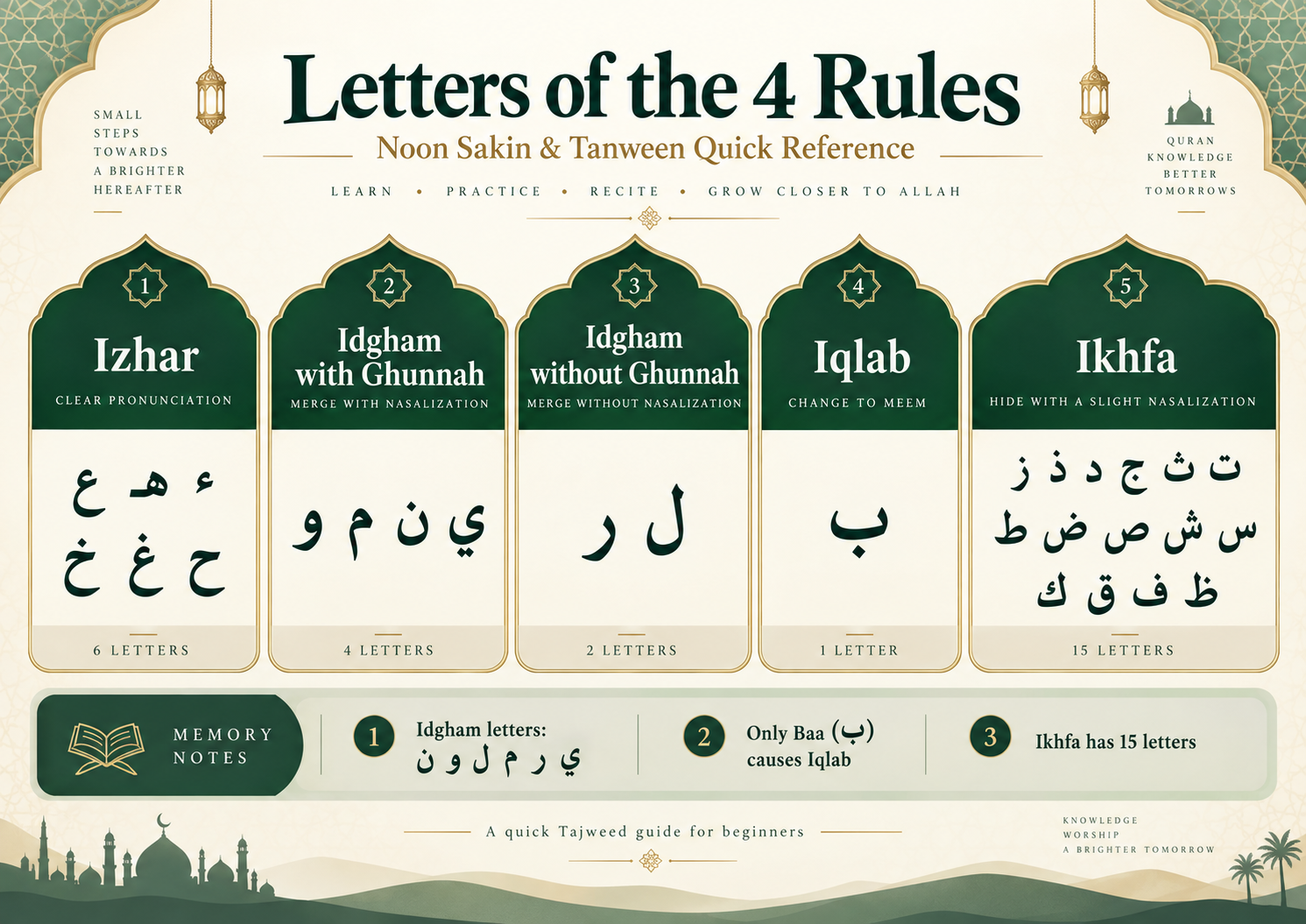
| Rule | What Happens? | Letters |
|---|---|---|
| Izhar | Noon sound is clear | ء هـ ع ح غ خ |
| Idgham with Ghunnah | Noon merges with nasal sound | ي ن م و |
| Idgham without Ghunnah | Noon merges without that Ghunnah | ل ر |
| Iqlab | Noon changes to a concealed Meem-like sound | ب |
| Ikhfa | Noon is partially hidden with Ghunnah | ت ث ج د ذ ز س ش ص ض ط ظ ف ق ك |
This table can be especially helpful when first memorising the Noon Sakin and Tanween rules.
Common Mistakes Beginners Make
Understanding the rules is one thing; applying them correctly while reciting takes practice.
One common mistake is pronouncing every Noon clearly. A learner may see نْ and automatically pronounce a strong “n” sound even when Idgham, Iqlab, or Ikhfa should apply.
Another common mistake is adding too much Ghunnah. Ghunnah should be controlled and natural. It should not become an exaggerated humming sound.
Beginners may also confuse Ikhfa and Izhar. With Izhar, the Noon remains clear. With Ikhfa, it is concealed with Ghunnah.
Another mistake happens in Iqlab, when learners continue pronouncing a clear Noon before ب instead of changing it toward a concealed Meem sound.
Some students also try to memorise all the letters without listening to their pronunciation. Knowing the rule on paper is helpful, but Tajweed is a practical skill. You also need to hear the difference between clear pronunciation, merging, changing, and hiding.
How to Practise Noon Sakin and Tanween Rules
Start by becoming comfortable recognising نْ and the three Tanween signs: ـً ـٍ ـٌ.
When you find one while reading, look immediately at the next letter and ask yourself which group that letter belongs to.
At first, practise one rule at a time. For example, spend one lesson finding only Izhar examples. Once they become easy to recognise, practise Idgham, followed by Iqlab and Ikhfa.
Reading aloud is also important. Tajweed cannot be mastered only by silently studying charts because pronunciation must be heard and corrected.
Try to listen to a qualified Quran teacher and repeat short examples slowly. Compare where the tongue, mouth, lips, and nasal sound are being used.
It is also helpful to study Makharij al-Huruf, the articulation points of Arabic letters. Understanding where letters are produced makes many Tajweed rules easier to apply.
Most importantly, practise regularly rather than trying to learn every rule at once. A few minutes of focused recitation every day can help the rules become more familiar.
Frequently Asked Questions
1. What are the four rules of Noon Sakin and Tanween?
The four main rules are Izhar, Idgham, Iqlab, and Ikhfa. The correct rule depends on the letter that appears immediately after Noon Sakin or Tanween.
2. Do Noon Sakin and Tanween follow the same Tajweed rules?
Yes. Although they look different in writing, they follow the same four rules because both produce a Noon-like sound in connected recitation.
3. What is the difference between Noon Sakin and Tanween?
Noon Sakin is an actual written Noon with Sukoon: نْ. Tanween is represented by double vowel marks ـً ـٍ ـٌ and produces an additional “n” sound without writing a Noon letter.
4. What are the Idgham letters?
There are six Idgham letters:
ي ر م ل و ن
The letters ي ن م و are used for Idgham with Ghunnah, while ل ر are used for Idgham without Ghunnah.
5. Which letter causes Iqlab?
Only one letter causes Iqlab:
ب
When Baa follows Noon Sakin or Tanween, the Noon sound changes toward a concealed Meem-like sound with Ghunnah.
6. How many Ikhfa letters are there?
There are 15 Ikhfa letters:
ت ث ج د ذ ز س ش ص ض ط ظ ف ق ك
When one of these follows Noon Sakin or Tanween, the Noon sound is concealed with Ghunnah.
7. What is the easiest way to learn Noon Sakin and Tanween rules?
First learn to recognise Noon Sakin and Tanween, then memorise the letters belonging to each rule. After that, practise real Quranic examples with a qualified Tajweed teacher who can listen to and correct your pronunciation.
Learn Noon Sakin and Tanween with Proper Tajweed
Understanding Noon Sakin and Tanween is an important step for anyone learning Quran recitation. Once you recognise the next letter, deciding whether to use Izhar, Idgham, Iqlab, or Ikhfa becomes much easier.
However, Tajweed is not only about memorising rules. Correct pronunciation requires listening, reciting, practising Ghunnah, and receiving feedback on how each sound is produced.
At As Sadiq Shia Online Quran Academy, students can learn Tajweed step by step with guidance suited to their level. Whether you are an adult beginning Quran recitation, a parent looking for Quran lessons for your child, or a non-Arabic speaker wanting to improve pronunciation, structured Tajweed lessons can help you build confidence and develop better recitation.
Explore the Tajweed classes at As Sadiq Shia Online Quran Academy and continue improving your Quran recitation one rule at a time.