
Tajweed · Beginner Guide
When learning Tajweed, you will often see the Arabic letter Meem with a Sukoon (مْ). This is known as Meem Sakinah. The way it is pronounced changes according to the letter that comes immediately after it.
Meem Sakinah has only three main Tajweed rules: Ikhfa Shafawi, Idgham Shafawi, and Izhar Shafawi. Once you learn which letters trigger each rule, identifying them while reading the Quran becomes much easier.
What Is Meem Sakinah?
Meem Sakinah means a letter Meem (م) carrying a Sukoon (ْ). It is written as:
مْ
A Sukoon means that the letter does not carry a Fathah, Kasrah, or Dammah. When you find مْ while reciting, look at the letter immediately after it. That next letter tells you which Meem Sakinah rule to apply.
The three possibilities are simple:
- Meem Sakinah followed by ب = Ikhfa Shafawi
- Meem Sakinah followed by م = Idgham Shafawi
- Meem Sakinah followed by any other Arabic letter = Izhar Shafawi
Why Are These Rules Called Shafawi?
The word Shafawi (شفوي) is related to the Arabic word for the lips. The letter Meem is pronounced by bringing both lips together, which is why the Tajweed rules connected with Meem Sakinah are described as Shafawi.
Correct lip movement is particularly important in Ikhfa Shafawi and Idgham Shafawi, where students must also pay attention to the nasal sound known as Ghunnah.
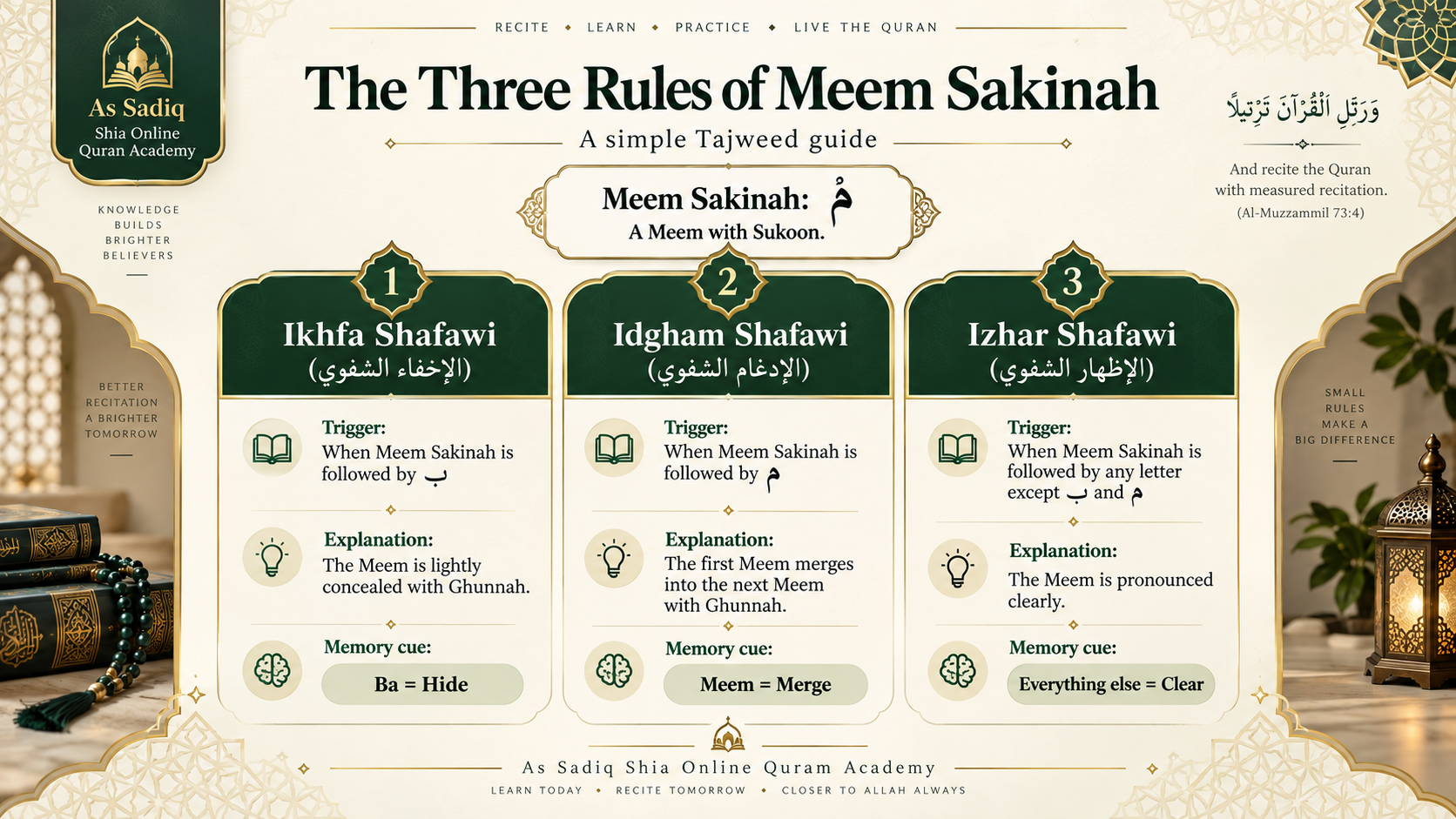
The Three Rules of Meem Sakinah
There are three rules to remember. Let us study each rule separately with its letter, pronunciation, and Quranic examples.
1. Ikhfa Shafawi
Ikhfa Shafawi occurs when a Meem Sakinah (مْ) is followed by the letter Ba (ب).
مْ + ب
The word Ikhfa means to hide or conceal. In Ikhfa Shafawi, the Meem is pronounced with a soft concealed sound together with Ghunnah, or nasalization.
How to Pronounce Ikhfa Shafawi
When Meem Sakinah comes before Ba, do not pronounce the Meem too strongly and do not completely merge it into the Ba. Keep a soft nasal sound for approximately two counts before moving into the letter Ba.
Quranic Example of Ikhfa Shafawi
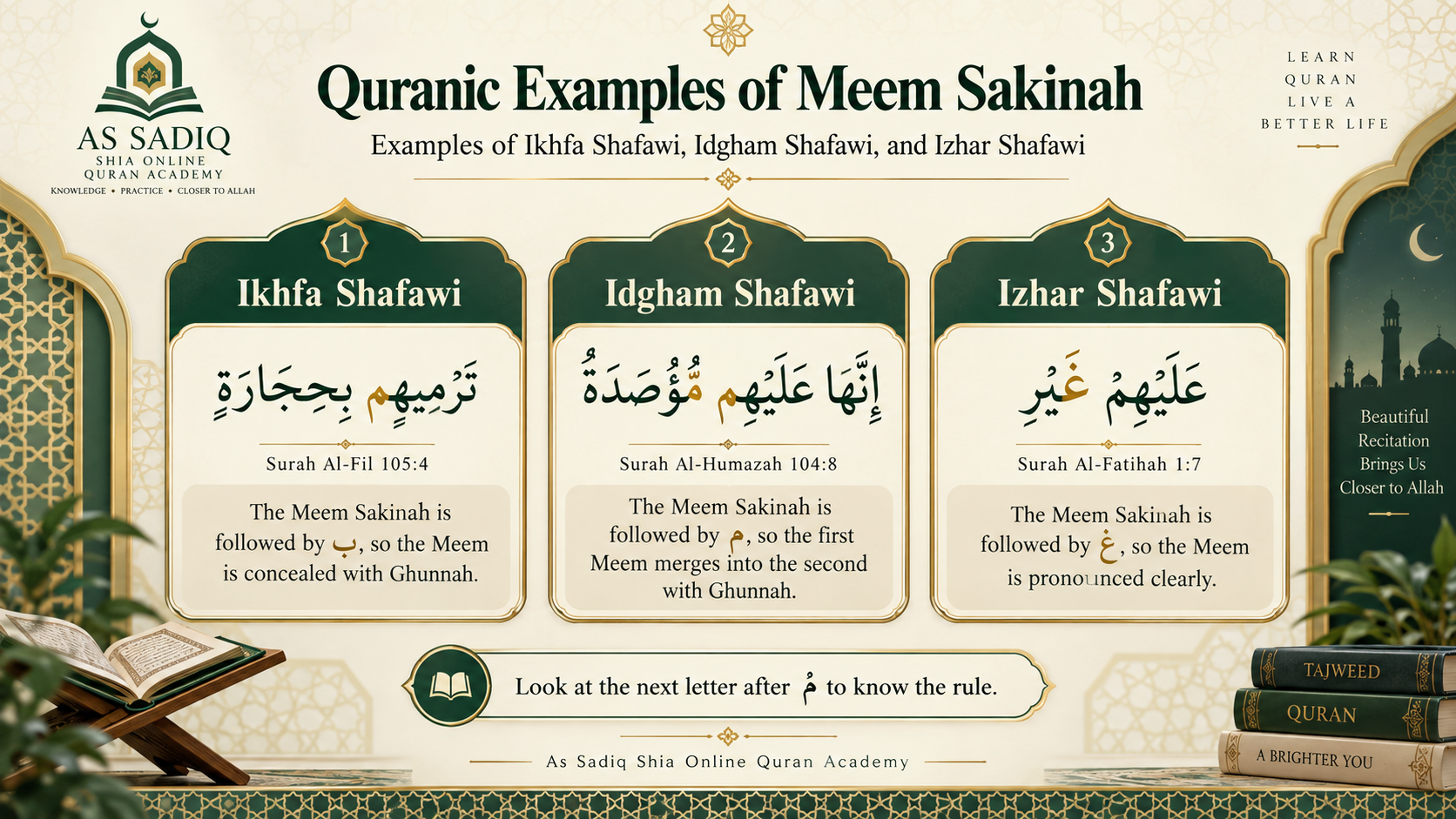
تَرْمِيهِم بِحِجَارَةٍ
“Striking them with stones...”
Surah Al-Fil, 105:4
Look at the connection:
هِمْ بِ
The Meem Sakinah in هِمْ is followed by Ba (ب). Therefore, the rule is Ikhfa Shafawi.
Another example is:
وَمَا هُم بِمُؤْمِنِينَ
Surah Al-Baqarah, 2:8
In هُم بِمُؤْمِنِينَ, the Meem Sakinah is followed by Ba, so Ikhfa Shafawi is applied.
2. Idgham Shafawi
Idgham Shafawi occurs when a Meem Sakinah (مْ) is followed by another Meem (م).
مْ + م
The word Idgham means to merge. The first Meem merges into the second Meem, producing one strengthened Meem sound with Ghunnah.
This rule may also be called Idgham Mithlain Saghir because two identical letters meet while the first one carries a Sukoon.
How to Pronounce Idgham Shafawi
Merge the first Meem into the second Meem and pronounce them as one clear, strengthened Meem while maintaining Ghunnah for approximately two counts.
The two Meems should not sound like two completely separate letters.
Quranic Example of Idgham Shafawi
إِنَّهَا عَلَيْهِم مُّؤْصَدَةٌ
“Indeed, it will be closed down upon them.”
Surah Al-Humazah, 104:8
Look at:
عَلَيْهِم مُّؤْصَدَةٌ
The word عَلَيْهِمْ ends with a Meem Sakinah and the next word begins with Meem. Therefore:
مْ + م = إدغام شفوي
The first Meem merges into the second with Ghunnah.
3. Izhar Shafawi
Izhar Shafawi occurs when a Meem Sakinah is followed by any Arabic letter except Ba (ب) and Meem (م).
The word Izhar means to make clear. Unlike Ikhfa, the Meem is not concealed. Unlike Idgham, it is not merged into the next letter.
Instead, the Meem Sakinah is pronounced clearly before moving to the following letter.
How to Pronounce Izhar Shafawi
Bring the lips together naturally to pronounce the Meem clearly, then move directly to the next letter. Do not hide the Meem and do not merge it into the following sound.
You should also avoid adding an unnecessarily prolonged Ghunnah.
Quranic Example of Izhar Shafawi
صِرَاطَ الَّذِينَ أَنْعَمْتَ عَلَيْهِمْ غَيْرِ الْمَغْضُوبِ عَلَيْهِمْ
Surah Al-Fatihah, 1:7
Look at:
عَلَيْهِمْ غَيْرِ
The Meem Sakinah is followed by the letter Ghayn (غ). Since Ghayn is neither Ba nor Meem, the rule is Izhar Shafawi.
Another example is:
أَلَمْ يَجْعَلْ كَيْدَهُمْ فِي تَضْلِيلٍ
Surah Al-Fil, 105:2
In أَلَمْ يَجْعَلْ, the Meem Sakinah is followed by Ya (ي), so the rule is Izhar Shafawi.
Meem Sakinah Rules at a Glance
| Rule | Letter After Meem Sakinah | How It Is Read |
|---|---|---|
| Ikhfa Shafawi | ب | Meem is softly concealed with Ghunnah. |
| Idgham Shafawi | م | First Meem merges into the next Meem with Ghunnah. |
| Izhar Shafawi | All letters except ب and م | Meem is pronounced clearly. |
A simple way to remember the rules is:
- Ba = Hide
- Meem = Merge
- Everything else = Clear
Difference Between Ikhfa Shafawi and Idgham Shafawi
Beginners sometimes confuse Ikhfa Shafawi and Idgham Shafawi because both involve Ghunnah. The easiest way to tell them apart is to look at the letter immediately after the Meem Sakinah.
If the next letter is Ba (ب), apply Ikhfa Shafawi.
تَرْمِيهِم بِحِجَارَةٍ
If the next letter is Meem (م), apply Idgham Shafawi.
عَلَيْهِم مُّؤْصَدَةٌ
In Ikhfa, the Meem sound is partially concealed. In Idgham, the first Meem merges into the second Meem.
Meem Sakinah vs Noon Sakinah and Tanween
Meem Sakinah and Noon Sakinah are both important Tajweed topics, but they do not use exactly the same rules.
Meem Sakinah has three main rules:
- Ikhfa Shafawi
- Idgham Shafawi
- Izhar Shafawi
Noon Sakinah and Tanween use four main categories: Izhar, Idgham, Iqlab and Ikhfa.
If you have not studied them yet, read our Noon Sakin and Tanween: Rules and Examples in Tajweed guide for a beginner-friendly explanation of all four rules.
Common Mistakes When Reading Meem Sakinah
1. Ignoring Ghunnah in Ikhfa Shafawi
Some beginners pronounce the Meem too quickly when it comes before Ba. Ikhfa Shafawi requires a soft nasal sound for approximately two counts.
2. Pronouncing Two Separate Meems in Idgham
In Idgham Shafawi, the first Meem should merge into the second. Reading both Meems as completely separate sounds misses the required merging.
3. Adding Too Much Ghunnah in Izhar
Izhar Shafawi requires the Meem to be pronounced clearly. Do not unnecessarily stretch or nasalize the sound as you would during Ikhfa or Idgham.
4. Looking Only at the Meem
You cannot identify the correct rule simply by finding a Meem Sakinah. Always check the letter immediately after it.
5. Incorrect Lip Position
The letter Meem is pronounced using both lips. Poor lip control can make the sound unclear, especially during Ikhfa Shafawi. Practising with a qualified Tajweed teacher can help correct these small pronunciation details.
How to Practice Meem Sakinah Rules
The easiest way to improve is to practise one rule at a time. Choose a short Surah and look for every Meem carrying a Sukoon.
Each time you find مْ, look at the next letter and ask:
- Is the next letter Ba (ب)? Apply Ikhfa Shafawi.
- Is the next letter Meem (م)? Apply Idgham Shafawi.
- Is it another letter? Apply Izhar Shafawi.
Start by reading slowly. Once you can recognize the rule correctly, gradually return to a natural recitation speed.
Listening to skilled Quran reciters is helpful, but direct feedback from a teacher is especially useful because pronunciation errors can be difficult to hear in your own voice.
A Simple Way to Remember Meem Sakinah
You do not need to memorize a long list of letters for Meem Sakinah. Remember only two special letters:
ب = Ikhfa Shafawi
م = Idgham Shafawi
Every other letter = Izhar Shafawi
This simple pattern makes the rules of Meem Sakinah one of the easier Tajweed topics to identify once you have practised them several times.
Learn Meem Sakinah with a Tajweed Teacher
Understanding a Tajweed rule on paper is an important first step, but Tajweed is ultimately learned through listening, recitation, and correction.
At As Sadiq Shia Online Quran Academy, students can study Quran recitation and Tajweed through personalized online lessons designed around their current level and learning pace.
Whether you are beginning with basic Quran pronunciation or want to strengthen rules such as Meem Sakinah, Noon Sakinah, Ghunnah, Madd and Qalqalah, structured guidance can help you recite with greater accuracy and confidence.